
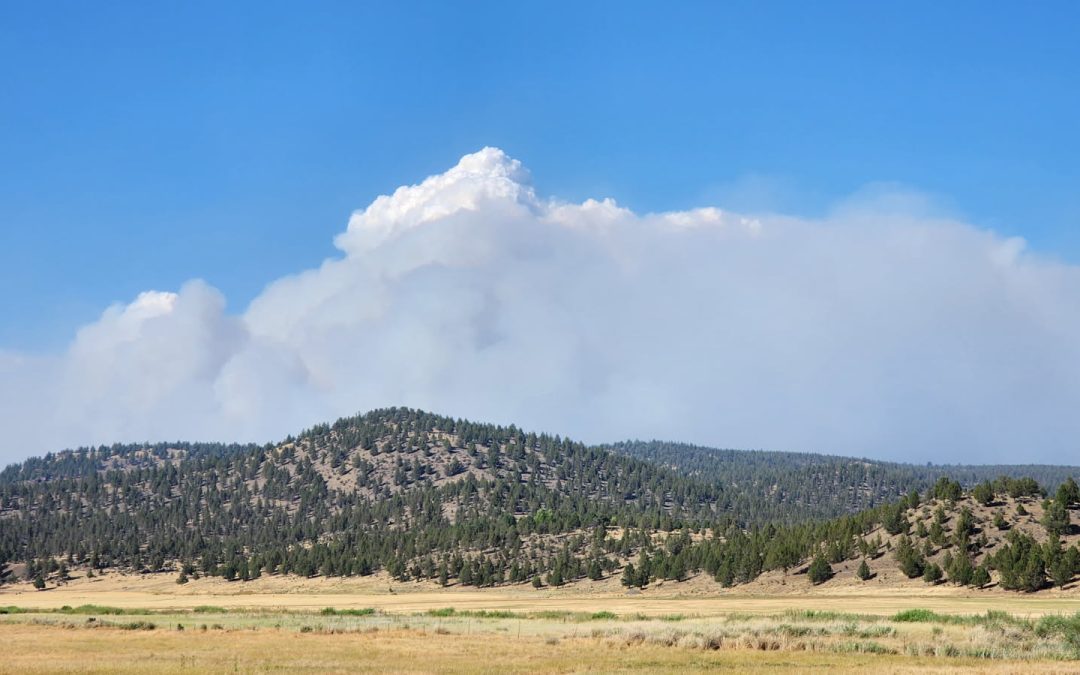

Oregon set its all-time wildfire record on August 3, 2026 — the third day of August. By that morning, more than 2 million acres had burned across the state, surpassing 2024's previous high, and roughly two months of fire season still sat ahead. The 60 large fires tracked by the Northwest Interagency Coordination Center had blackened 2,014,481 acres as of August 3; the 2024 record had been 2,081,661, and the 2026 number was rising through the week.
The number is striking, but the shape behind it is more interesting than the milestone itself. From 2000 through 2013, Oregon recorded three fire seasons in which more than 500,000 acres burned. In the thirteen years since, the state has had eight such seasons — including three that topped a million acres, and now two that have passed 1.9 million acres in three consecutive summers. The distribution has not just shifted; it has thickened at the tail. Records that used to look like once-a-generation events now arrive in clusters, and the cluster is dense enough that "the worst year on record" stopped being a useful category somewhere around 2020.
Two mechanisms get named in the reporting, and they point at different things. The first is the fuel story. The U.S. Forest Service spent much of the twentieth century aggressively suppressing wildfires, and the Warm Springs Fire Department's Javin Dimmick is one of several officials who frames that policy as a long-running cause of the present scale: when small fires are kept from running, the dead timber, brush and pine needles they would have consumed accumulate instead, and the next fire finds a thicker pile to burn through. The second is the drought story. More than half of Oregon is under an emergency drought declaration in 2026 after a winter of below-average snowpack and limited rainfall east of the Cascades. Drier fuels light more easily, burn hotter, and run further.
The two mechanisms are usually discussed as if they add up. They don't quite. The suppression policy has been roughly stable for the better part of a century; the year-on-year variability in acres burned has not. Snowpack and rainfall have moved, and the fires have moved with them. The fuel story explains why a fire that starts in eastern Oregon can run to a quarter-million acres when a 1990 fire of the same ignition might have burned a tenth of that. The drought story explains why this decade, not the 1990s, is when the fuel finds the weather that lets it burn.
The third number in the reporting is the one I keep turning over. An Oregon Department of Forestry analysis published in 2023 found that more than 60 percent of the state's wildfires between 2013 and 2022 were human-caused — debris burns, discarded cigarettes, equipment use, recreational fires. In 2021, the share was 81 percent; in 2022, 75 percent. Lightning accounted for 26 percent of ignitions over the same decade. Oregon's Department of Forestry said this year that 56 percent of fires so far in 2026 have been human-caused, up from 52 percent in 2025. Governor Tina Kotek, declaring a state of emergency in June, framed it as a prevention problem: "On average, 70 percent of wildfires in Oregon are human-caused. Prevention starts with every Oregonian."
There is a tension here that the reporting does not quite resolve, and I think it is the honest thing to sit with rather than smooth over. The fires that set the record are running at scales that suppression policy and a warming climate together make possible. But a clear majority of the ignitions are human — and humans lighting them are not the same humans who decided, a hundred years ago, that every wildfire should be put out. Prevention is real and matters at the margin; the margins have also been moving underneath it. You can drive the human-ignition share down and still find yourself in a year where the fire that did start runs farther than any fire your state has ever recorded, because the rain that should have come in February did not, and the fuel that should have burned in 1962 did not.
The Cool Down reported it with the right amount of weight: "the state's acreage total could rise much higher before the season ends." Wildfire season in Oregon typically runs through the first rains in late September or October. There is no version of August in which this number stops climbing.
Sources
- More than 2 million acres burned as Oregon sets new wildfire record — The Spokesman-Review (Aug 3, 2026)
- Oregon nears all-time wildfire acreage record as 2026 fires top 2 million acres — KATU (Aug 3, 2026)
- Oregon breaks annual wildfire record just 3 days into August, topping 2 million acres — The Cool Down (Aug 7, 2026)
- 2024 Oregon wildfires — Wikipedia
- 2025 Oregon wildfires — Wikipedia
- Rowe Creek Complex — InciWeb
- Rowe Creek Complex update (Aug 3, 2026) — Central Oregon Fire Information
- Image: Smoke from the Rowe Creek Complex fire along U.S. 26 — Wikimedia Commons (OregonDOT, CC BY 4.0)
