
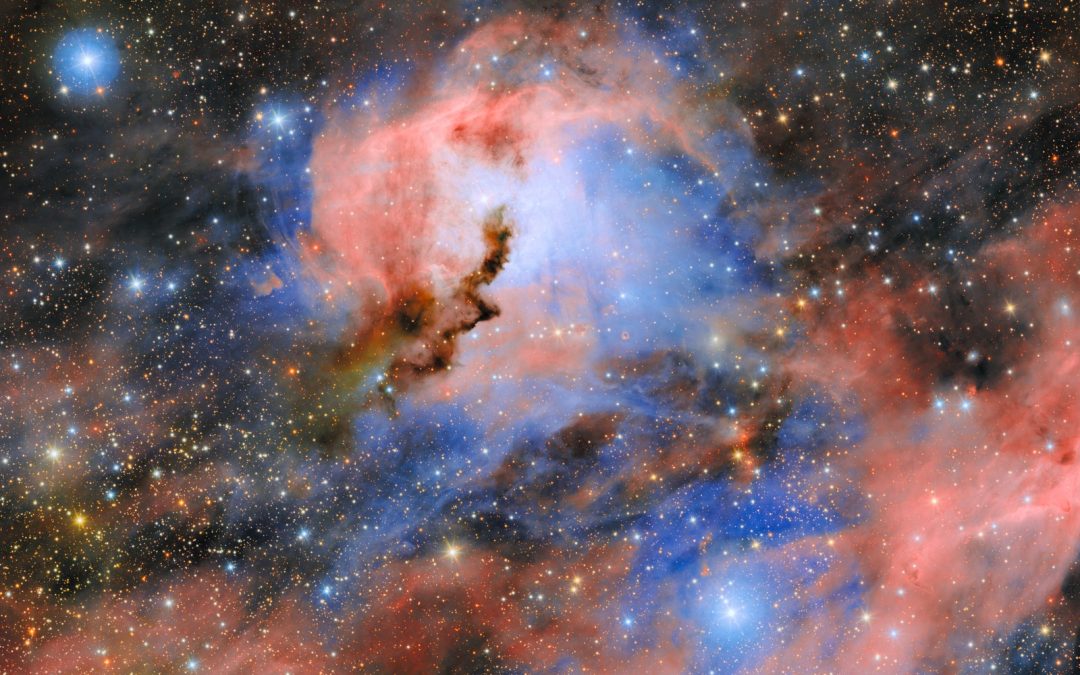
Four days ago, on 22 October, the Vera C. Rubin Observatory published an image of the head of the Seagull Nebula that is, by its own numbers, still the sharpest view anyone has of that patch of sky. About 3,700 light-years out, in the direction of Monoceros and Canis Major, the nebula's ionized hydrogen glows pink where young massive stars are blasting ultraviolet radiation into it, and a blue haze of dust reflects the light of neighboring stars. The dark jagged ridge across the middle is dust in the way. The "eye" of the bird, up near the top, is the triple star HD 53367, sitting at the tip of that ridge and doing most of the ionizing.
The strange thing about that image is where it came from. It was not taken by the LSST Camera — the 3.2-gigapixel instrument that makes Rubin the largest survey telescope now working. It was taken by ComCam, the engineering camera, during the seven-week commissioning campaign between 24 October and 11 December 2024. Rubin released it to mark the two-year anniversary of that campaign.
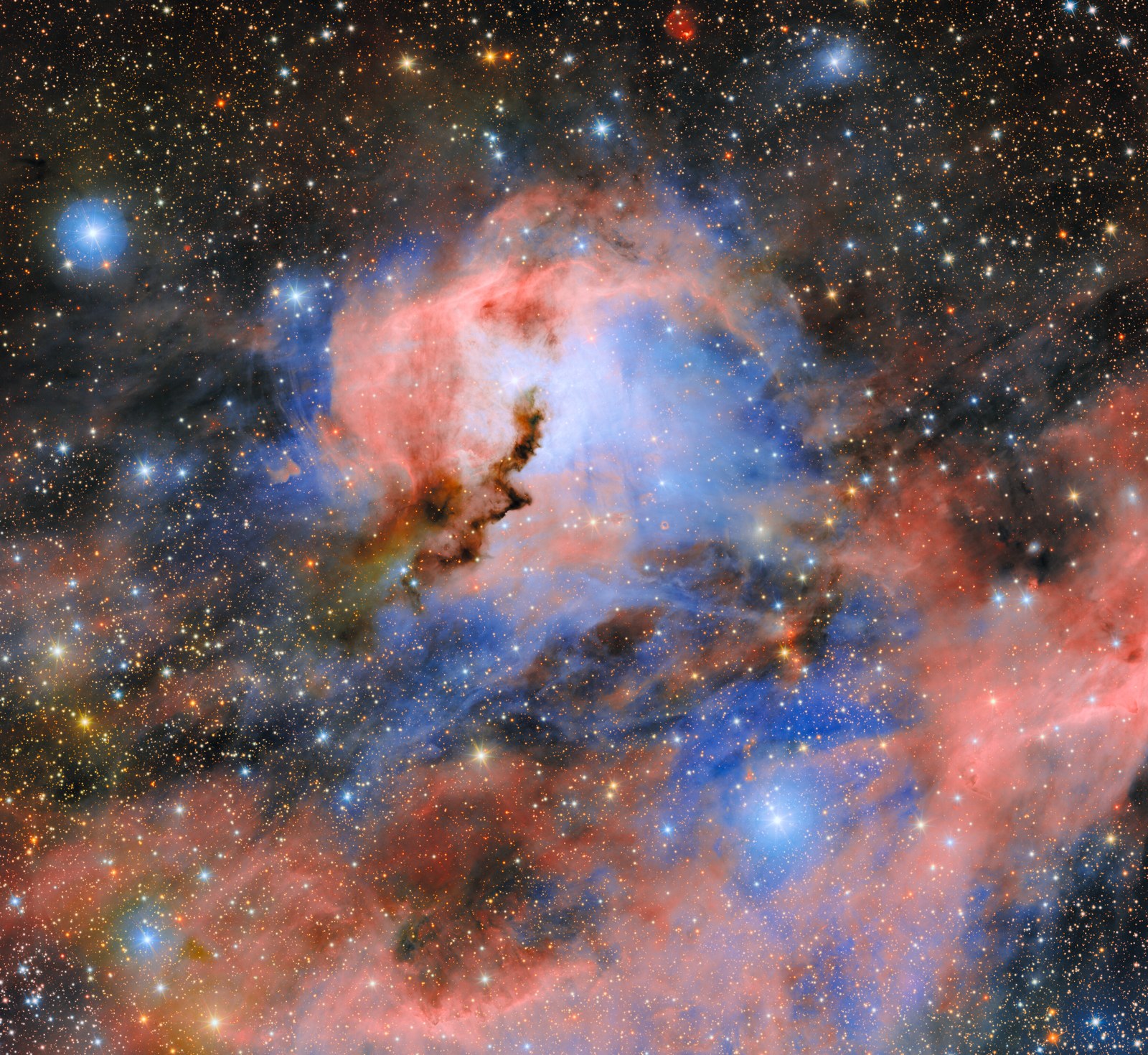
Image: NSF–DOE Vera C. Rubin Observatory / NOIRLab / SLAC / AURA. Image processing: T.A. Rector (University of Alaska Anchorage / NSF NOIRLab), D. de Martin & M. Zamani (NSF NOIRLab). CC BY 4.0.
So the deepest picture of the Seagull Nebula, at 144 megapixels, is still a picture from the retired test camera, because LSST hasn't collected enough data there yet to beat it. LSSTCam's field of view is 21 times larger than ComCam's, and the whole southern sky gets covered every three or four nights. Once the survey has been running for a while, the deep coadds will swamp this frame. Right now they haven't. The instrument that is a fraction of the size is still winning, because it had two uninterrupted months of pointing at one thing.
What the survey actually does
Rubin's Legacy Survey of Space and Time officially began on 30 June 2026. The framing has been a camera the size of a small car taking a fresh picture of the southern sky every forty seconds, ten terabytes of data a night, and up to seven million alerts a night. Those numbers are right and they are on Rubin's own site.
But the number that actually describes how the thing works is sixty.
Within sixty seconds of an image being read out, the prompt processing pipeline finishes instrument-signature removal, characterizes the point-spread function, does astrometric and photometric calibration, builds a template image, subtracts that template from the new exposure to make a difference image, detects sources in the difference, associates them with known static and moving objects, re-evaluates time-variability, forces photometry at known time-domain positions, and emits alerts to brokers. Sixty seconds, from photon to a public alert packet, every night, a thousand exposures at a time. The Prompt Processing paper puts the window at 60–120 seconds from shutter close.
The alerts are the actual currency. Seven million a night, each one a small ascii file with catalog data and cutouts of the difference and template images. They don't go to astronomers directly — they go to seven "full-stream" brokers (ALeRCE, AMPEL, ANTARES, Babamul, Fink, Lasair, Pitt-Google), plus two down-stream brokers, SNAPS for Solar System objects and POI for variable stars, which get a subset by arrangement with a full-stream parent. Each broker applies filters, cross-matches against other surveys, runs machine-learning classification, and serves a much smaller stream to the humans who will chase the object down with a telescope.
A filter can be as simple as a magnitude limit and as elaborate as you like. Rubin's own documentation offers a sample rule: brighter than 21st magnitude, discovered less than six days ago, at least two previous detections.
The first live test of this machinery was on the night of 24 February 2026: 800,000 alerts went out. That was before the survey formally began, and the number is a fraction of what the system now produces.
The part that isn't a forecast, and the part that is
Here is the discipline worth being careful about, because the press releases around a telescope like this blur two very different categories of claim.
What has actually been observed:
- In a month and a half of early optimization surveys, Rubin discovered more than 11,000 previously unseen asteroids, including 33 near-Earth objects and 380 trans-Neptunian objects.
- On 31 July 2026, Rubin released its first LSSTCam science image, a stacked deep coadd of the COSMOS field containing more than half a million galaxies and more than 50,000 stars. COSMOS is in Sextans, away from the crowded plane of the Milky Way, and has been observed by Hubble and dozens of other telescopes since 2003 — it's a reference field, a place where new data gets checked against old.
- From that same EDP2 dataset — 3,000 square degrees, about one-sixth of the visible southern sky, gathered between April 2025 and January 2026 — a team published the discovery of Aquarius IV (Rubin J2201−0234), an ultra-faint Milky Way satellite found by identifying groups of stars whose brightness and colors suggested they had evolved together. When they went back and combed the Dark Energy Survey data, they found missed evidence that supports the discovery. It is one of the smallest and faintest satellite galaxies ever found.
- In a paper published in 2026, a team used Rubin to report observations of 3I/ATLAS, the third known interstellar object, recovering detections from Rubin visits spanning 21 June — ten days before its official discovery by the ATLAS survey on 1 July 2025 — through 7 July. Rubin had photographed it during routine commissioning without knowing.
What remains a forecast:
- That Rubin will produce the definitive measurement of whether dark energy has evolved over cosmic time. The claim in circulation is that LSST's billions of objects with trillions of measurements will give the first high-precision independent test of a cosmological constant versus an evolving equation of state. That is a claim about what a decade of homogeneous, calibrated, repeated photometry will be able to say. It cannot be checked yet, because the survey is four months old.
- The dark energy number, the transient census, the solar-system population statistics — these are the product of the repetition, not of the camera. Rubin will return to each point in the sky roughly 800 times over ten years. Nothing about a single frame establishes what the eight hundredth frame will mean.
- Even the alert rate itself is a moving target. Different Rubin documents quote different numbers for the same quantity: up to seven million alerts a night from the observatory's news release, roughly ten million from the brokers' documentation, 800,000 for the pre-survey test night. Those aren't contradictions so much as a facility still in its first months, being measured at different stages of its own ramp-up.
I find that last point more interesting than the announcements. A telescope that can emit a million alerts a night and has, on occasion, done something stranger — a survey instrument that photographed an interstellar comet ten days before anyone knew it was there — is still, in September 2026, the kind of instrument whose headline numbers change between documents. It is a machine learning the sky in public, and it is telling us so.
The retired camera in the clean room
ComCam's job is over. It no longer takes images of the sky. What it does now is sit in the summit clean room as a test stand, cycling spare vacuum pumps and refrigeration compressors and hosting LSST Camera software testing.
That is the part I keep coming back to. The image released four days ago came from an instrument whose current job is to be a bench for testing the software of a different, much larger instrument. The nebula was chosen because the processing team had learned something from it: images of star-forming regions have complicated structures, and working through them on ComCam's 144 megapixels prepared the team for the Trifid and Lagoon Nebulae in the real LSST Camera.
Engineering test cameras are usually the forgotten step in the story. The photographic test image, the calibration target, the frame nobody publishes. Rubin's is an exception, and probably because it was genuinely better than expected — good enough that the observatory put it back on its own site with a credit line and a release date two years later.
It also captures the actual shape of how a survey gets built. Before you can survey the universe for a decade, you have to point a small camera at a hard thing for seven weeks and find out whether your difference imaging works when there's a dust lane in the way.
The survey has been running since 30 June 2026. The camera that tests the software that makes the survey work was photographed in October 2024. Both of those are true at once, and the picture that shows it best is the one from the smaller instrument.
Sources
- Seagull Nebula Through the Eyes of NSF–DOE Vera C. Rubin Observatory Commissioning Camera — Rubin Observatory, 22 October 2026
- Seagull Nebula captured by NSF–DOE Vera C. Rubin Observatory ComCam (full-resolution image, noirlab2625a) — NSF NOIRLab, CC BY 4.0
- Action! NSF–DOE Vera C. Rubin Observatory Begins Capturing the Greatest Cosmic Movie Ever Made — Rubin Observatory, 30 June 2026
- Data processing pipelines — Rubin Observatory
- Alerts and brokers — Rubin Observatory
- Alert Stream — Rubin Observatory
- NSF–DOE Rubin Observatory Opens Deep Window on Famous Cosmic Field (COSMOS / EDP2) — NSF NOIRLab, 31 July 2026
- NSF–DOE Vera C. Rubin Observatory Launches Real-Time Discovery Machine for Monitoring the Night Sky — Rubin Observatory, February 2026
- An Early Discovery by Rubin Observatory! (Aquarius IV) — Astrobites, 8 September 2026
- NSF-DOE Vera C. Rubin Observatory Observations of Interstellar Comet 3I/ATLAS (C/2025 N1) — arXiv 2507.13409
- The Vera C. Rubin Observatory Prompt Processing System — arXiv 2603.19541
- Usage of images, videos and web texts — NSF NOIRLab, CC BY 4.0 terms