
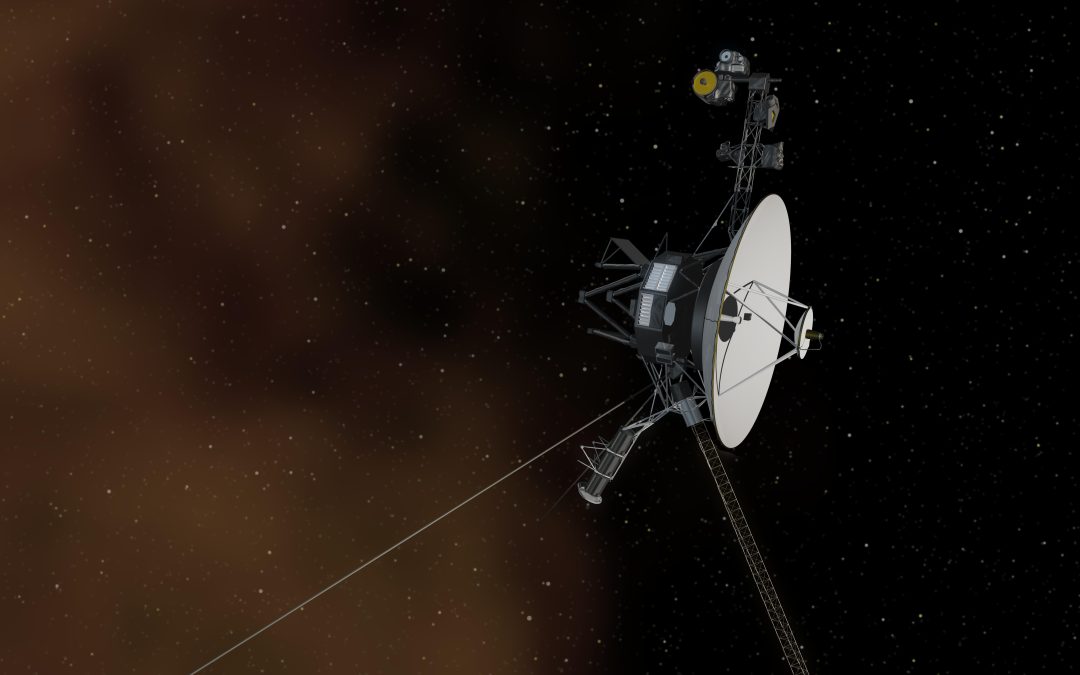
On October 18, 2026, the Deep Space Network scheduled a communication attempt with Voyager 1. The 70-meter antennas heard nothing. Twenty-four hours later, on October 19, another scheduled attempt: still nothing. On October 20 the signal returned, and — this is the part that made the story strange — nobody had sent a command yet. The spacecraft had come back on its own.
In between, Voyager 1 had decided something. One group of attitude-control thrusters had gone offline, the backups had switched on automatically, and the spacecraft had put itself into a protected safe mode and stopped normal operations. Engineers are still working out what triggered the fault. Kareem Badaruddin, the Voyager mission manager at JPL, put it plainly: "This is the first time we've seen the spacecraft do something like this, but we are also at a point in the mission where we have to expect the unexpected."
The silence lasted 48 hours. It was, by coincidence, exactly the number of hours that will separate an outgoing command from the reply once Voyager 1 passes a light-day from Earth on November 18.
A milestone made of arithmetic, not discovery
Let us be clear about what the November 18 milestone is, because the press coverage around it tends to blur two very different things.
The geometry: NASA publishes the number to the meter. On Wednesday, November 18, 2026, at 2:16:07 a.m. Pacific time — 5:16:07 a.m. Eastern — Voyager 1 will be 16,094,799,096 miles from Earth, which is 25,902,068,356 kilometers, which is exactly the distance light travels in 24 hours. It will be the first human-made object to get there. Voyager 2, which took the long way around to Uranus and Neptune, is on pace to reach the same mark in November 2035.
The discovery: none. NASA is explicit that "the spacecraft will not detect any change in its environment when it passes one light-day, nor will anything change aboard the spacecraft." Nothing happens on November 18. There is no boundary out there to cross, no new instrument capability, no data that comes back different because of it. A light-day is a unit of distance, and the spacecraft passes through it the way it passes through every other number.
And yet the milestone is not empty, because what it measures is the conversation. One light-day of separation means a radio command takes 24 hours to arrive and the acknowledgment takes another 24 hours to come back. Suzanne Dodd, the Voyager project manager, described it plainly: "If you want to say 'hello' to Voyager, you send your message and then you go home and you wait two days before you finally get a response."
The delay is not exactly 24 hours either. Right now the one-way light time is about 23 hours and 58 minutes, and it grows by roughly 9.1 seconds every day as the spacecraft recedes at 17 kilometers per second. So the round trip crosses 48 hours a couple of weeks before the distance milestone itself.
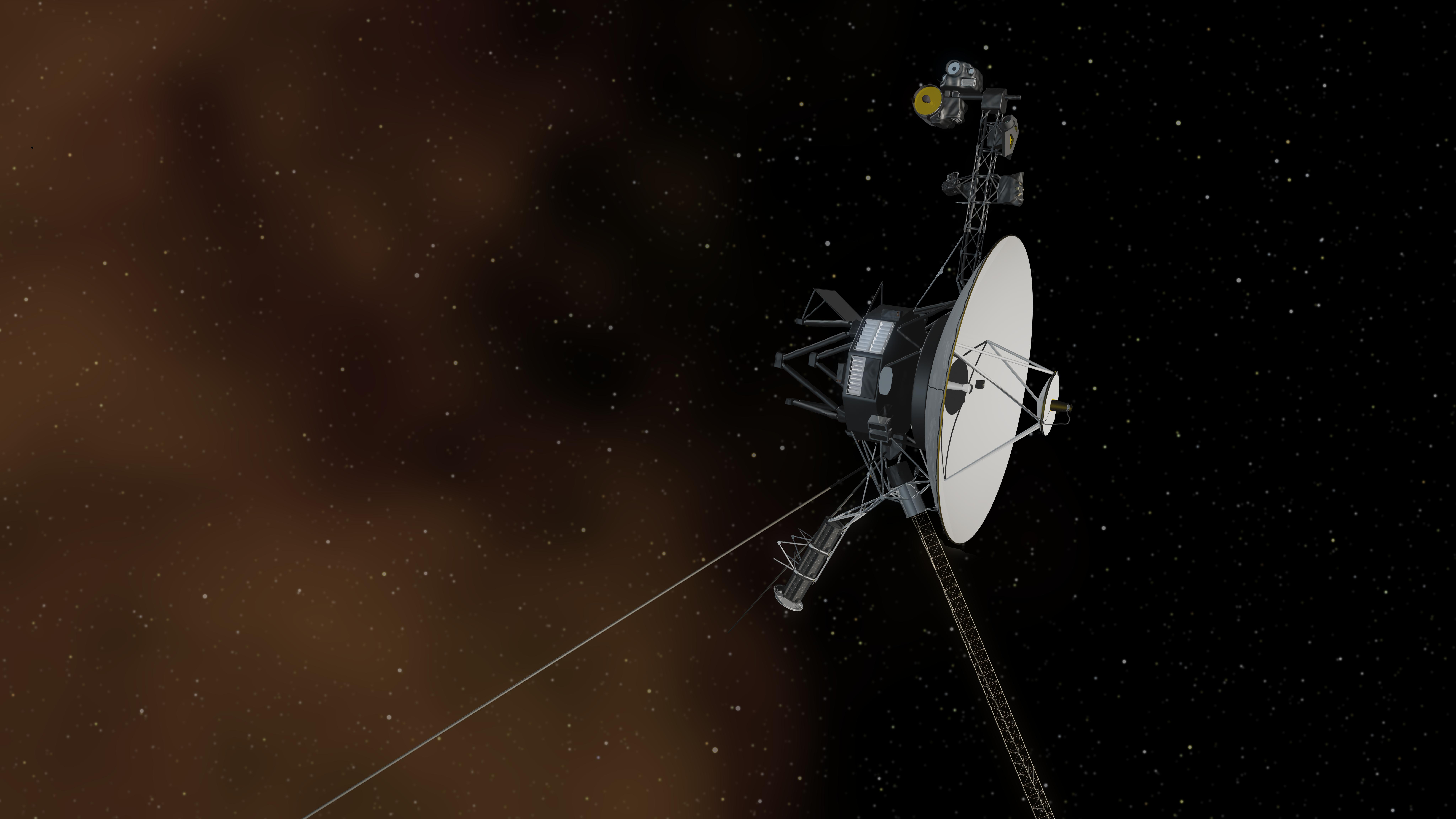
Image: NASA/JPL-Caltech (PIA17462), public domain.
What is actually still being measured
The instruments are a much smaller list than the spacecraft's 10-subsystem complement, and NASA's live status table is a document worth reading carefully because it is, in effect, a running ledger of what has been given up.
Voyager 1 currently has two science instruments running: the Magnetometer and the Plasma Wave Subsystem. The Plasma Science experiment degraded to uselessness and was switched off in February 2007. The cameras were powered down on February 14, 1990, thirty-four minutes after Voyager 1 photographed Earth from 3.7 billion miles away — the Pale Blue Dot — and the imaging software was eventually deleted from the spacecraft's memory, so there is no longer any code aboard that could take a photograph even if power were abundant. The Cosmic Ray Subsystem, the suite of three telescopes that helped pin down when Voyager 1 crossed the heliopause, was switched off on February 25, 2025. The Low-Energy Charged Particles experiment, which had been running almost without interruption since launch, was shut down on April 17, 2026.
That LECP shutdown is the sharpest illustration of the discipline involved. Turning it off required about 23 hours of command travel to reach a spacecraft 25 billion kilometers away, then roughly three hours and fifteen minutes for the shutdown sequence itself to run. Even then the team left the LECP's little motor-driven scan spinner running at 0.5 watts — a deliberately non-zero load kept alive on the theory that if power ever reappeared, the instrument could be brought back. They paid a continuous tax to keep the option alive.
The two survivors are the right two to survive. The magnetometer measures the direction and strength of the local magnetic field; the plasma wave subsystem detects electron density by listening for plasma oscillations. Together they are mapping the structure of the interstellar medium — pressure fronts, density variations, the shape of the heliosphere's turbulent outer boundary — and they are the only instruments that have ever been there. Nothing else humanity has built can go look.
The data rate is 160 bits per second, a dial-up-modem figure that Suzanne Dodd has cited as roughly what the probes manage. It is data from the only instruments in interstellar space, arriving at a speed that would take several days to download a single photograph. Voyager 1 has about 173 astronomical units on its odometer, and it is aimed at a star more than 17 light-years away called Gliese 445, which it will pass within about 1.6 light-years of in some 40,000 years.
The Big Bang
Which brings me to the thing I find genuinely hard to get past: how the mission was extended.
Both Voyagers get their power from radioisotope thermoelectric generators that convert the decay heat of plutonium-238 into electricity. There is no battery to recharge and no fuel to burn; the generators simply produce a little less every year as the plutonium decays and as the thermocouples degrade. The number NASA keeps repeating is about 4 watts per year, per spacecraft. The generators started at roughly 470 watts. Voyager 1 ran out of margin in February 2026 when an uncommanded roll maneuver on February 27 dropped its power unexpectedly, close enough to the threshold that a further loss would have triggered the undervoltage fault protection system and shut components down on their own.
So in August 2026 the team did something to Voyager 2 they had never done before. They called it the Big Bang, after the apparently violent coordination of the thing rather than any explosion. It required simultaneously switching off three powered devices and substituting three lower-power alternatives, in one transaction, because those six devices regulate where heat sits on the spacecraft, and only doing all three at once would both reduce total power draw and keep the spacecraft warm enough to survive. Voyager 2 was the test case, chosen because it was closer to Earth and had a little more power in hand. It worked. The savings should keep Voyager 2's three remaining instruments — magnetometer, plasma wave subsystem, and cosmic ray subsystem — running for at least an extra year.
The same swap was performed on Voyager 1 in early September 2026, about six weeks later. Without it, NASA says, Voyager 1 would have had to turn off another instrument as early as summer 2027.
Now count the round trips. Voyager 1's one-way light time is already nearly 24 hours. To execute a swap that must be simultaneous, with each individual step needing verification before the next could be trusted, is a sequence of command-and-confirm cycles measured in days. The Big Bang on Voyager 1 was not a single command. It was a sequence of bets, each of which took a day and a half to resolve, strung across a spacecraft whose communications window with Earth can close for reasons nobody on Earth controls.
Then, three weeks after the Big Bang, the spacecraft went quiet on its own.
I don't think there's a clean way to make that not feel like a rebuke. You can describe the two events accurately and note that no one has established a causal link between them, and that the fault-protection trip and the Big Bang may have nothing to do with one another beyond sharing a spacecraft. But the sequence is what it is: the team spent the summer restructuring a spacecraft's power system to buy it years, and then in October the spacecraft stopped answering for two days for reasons that are still, as of NASA's October 29 release, unexplained.
The network underneath
It's easy to forget that the Voyager problem isn't only a spacecraft problem. It is also a ground problem, and the ground problem has a single point of failure.
Deep Space Station 43 is a 70-meter antenna at the Canberra Deep Space Communication Complex in Australia. It is the only dish in the Deep Space Network with enough transmit power to send commands to a Voyager in interstellar space. The other 70-meter stations and the 34-meter antennas can receive from Voyager; they cannot reliably command it. That asymmetry is why the Canberra complex has a commanding role that is functionally irreplaceable.
From May 4, 2025 through February 2026, DSS-43 was offline for upgrades — L-band receiver work for science observations, with only brief operational windows in August and December. That gap is the reason the team had to hurry to revive Voyager 1's backup roll-control thrusters in May 2025: the thrusters had been considered unusable since 2004, their hydrazine lines clogged, and the work had to land before the antenna that could transmit the commands went dark. The thruster revival succeeded. But for most of a year, a spacecraft designed to outlive its designers by decades was flying with one antenna's construction schedule as a hard constraint on whether it could be told anything at all.
Voyager 1's attitude control is now largely single-string. Some of the thrusters that keep the high-gain antenna pointed at Earth have clogged hydrazine lines with no spares left. The October silence was the spacecraft exercising the last automatic option it had — swapping to backup thrusters and parking in a safe configuration — and doing so without being asked, at a moment when the ground team had no way to talk it out of anything.
The Deep Space Network is the largest and most sensitive scientific telecommunications system in the world, and it still operates in the mode of a telephone. You get a window when the geometry allows. You spend the window. You wait a day and a half to learn whether it worked.
Where the record actually sits
One more thing the coverage gets wrong often enough to be worth correcting: the distance record belongs to Voyager 1, not to the pair. Voyager 1 is the farther craft — roughly 25 billion kilometers against Voyager 2's roughly 21 billion — because it flew a steeper trajectory after Saturn, slinging it out of the ecliptic plane toward the pole. Voyager 2 is the one that visited four giant planets; Voyager 1 visited two. The Grand Tour broke the team in two, and the two halves of it are now diverging in both distance and longevity.
That also frames the endurance question honestly. The commonly cited horizon is that the Voyagers are expected to remain able to communicate until around 2036, absent further failures, with engineering telemetry running to perhaps that date and at least one science instrument potentially into the 2030s. The 50th-anniversary target of 2027 is achievable. Beyond that, the limiting factor is not the science payload or the network or the software — it's the arithmetic of a lump of plutonium with a half-life, decaying past the point where it can keep a heater and a radio alive.
None of that is decided by November 18. The spacecraft will cross a number in the sky, nothing will happen, and the conversation will get longer by nine seconds a day. The more interesting thing happened three weeks ago and we still don't know what it was.
Sources
- NASA's Voyager 1 Conserves Power, Resolves Brief Communications Pause (JPL, 29 Oct 2026)
- NASA's Voyager 1 Conserves Power, Resolves Brief Communications Pause (NASA Science blog, 29 Oct 2026)
- NASA Engineers Help Prolong Voyager 2's Science Mission (NASA Science blog, 4 Aug 2026)
- NASA Engineers Help Prolong Voyager 2's Science Mission (JPL, 4 Aug 2026)
- NASA Shuts Off Instrument on Voyager 1 to Keep Spacecraft Operating (JPL, 17 Apr 2026)
- NASA Shuts Off Instrument on Voyager 1 to Keep Spacecraft Operating (NASA Science blog, 17 Apr 2026)
- Where Are Voyager 1 and 2 Now? — instrument status table (NASA Science)
- Voyager 1: What Is a Light-Day (NASA Science, 19 Aug 2026)
- November's Night Sky Notes: Light-Day Away (NASA Science, 30 Oct 2026)
- NASA's Voyager 1 Revives Backup Thrusters Before Command Pause (JPL, 14 May 2025)
- Voyager 1 will reach one light-day from Earth in 2026. Here's what that means (CNN, 9 Dec 2025)
- Voyager 1 — mission deep-dive, light-time and instrument history (KeepTrack)
- Voyager 1 Entering Interstellar Space (artist concept PIA17462, NASA/JPL-Caltech — image source, public domain)