
There is a specific number I came looking for and did not expect to find: 99.54%.
It is the fraction of sky pixels in the second of SPHEREx's four planned all-sky surveys that received an observation in every spectral channel — and it is the worst of the four. The mission's own requirement was a more modest ">90% per survey," so the mission is flying four times better than it promised on its worst survey, and the planners know which one is the worst and can say so.
That number matters more than it looks. It sits inside a design choice that I think is the most interesting thing in astronomy right now, and it is the opposite of what most people assume about telescopes.
The trade
SPHEREx is a 20-centimeter telescope. That is the diameter of the objective, roughly the size of a dinner plate. It launched on a Falcon 9 from Vandenberg on March 11, 2025, at 8:10 p.m. PDT, riding along with the PUNCH coronagraphs as a rideshare.
A 20 cm aperture is tiny by the standards of the great observatories. James Webb's primary mirror is 6.5 meters across; that is roughly thirty times the collecting area of SPHEREx's entire telescope. Webb can do spectroscopy with far more wavelengths at far greater resolving power, in a field of view thousands of times smaller.
What SPHEREx bought with that trade is coverage. Six detectors, each behind a linear variable filter carrying a gradient of 17 colors, gives 6 × 17 = 102 spectral channels per exposure. The telescope points the filters across the sky in overlapping latitude rings, and because the spacecraft orbits at a 97° inclination, the field of view sweeps north to south and returns, with the ecliptic poles getting 50–100 times the redundancy of everywhere else.
The design is a deep-field survey where the deep field is the entire sky, and the "resolution" is 6.2 arcsecond pixels.
What the numbers actually say
The mission paper (Bock et al., submitted to the journal in late 2025) and the instrument paper (Korngut et al.) give me a clean line between what was promised and what was delivered:
| Quantity | Specification / requirement | Measured in flight |
|---|---|---|
| Wavelength coverage | 0.75–5.0 μm, 102 channels | measured band centers to <1 nm (bands 1–4), <10 nm (bands 5–6) |
| Resolving power | R = 35–130 (six bands, R ≈ 40 / 110 / 130) | measured to within 5%, agrees with design to within 10% |
| Point-source depth (5σ) | ≥ 18.4 AB mag required in bands 1–4 | median 19.7 AB mag — exceeds requirement |
| All-sky point-source depth | — | 19.5–19.9 AB mag (0.75–3.8 μm), 17.8–18.8 AB mag (3.8–5.0 μm) after four sky passes |
| Spatial resolution | 6.2″ pixels (chosen as the optimum) | Neff typically 2–3 pixels per source |
| Voxel completeness | > 90% per survey | 99.54% on the worst of four surveys |
| Survey redundancy | ≥ 4 spectra per sky position | 4 (all-sky) to ~200 (deep fields) |
The line I keep returning to is the third row. The cosmology team required 18.4 AB mag at 5σ per channel, because that threshold set the galaxy counts they needed to constrain inflationary non-Gaussianity. The instrument came in at 19.7 AB mag median. It overshot the science requirement by more than a magnitude, and the official summary line from the data team is blunt: in all cases other than the helium contaminated 1.083 μm channel, the actual performance is as-good-as or better than the original projected performance estimates — where "original projected performance estimates" means the 2018 concept study report, the pre-launch forecast.
But that same sentence contains the sharp edge, and it's the most interesting thing I learned today.
The one channel that failed
Earth's atmosphere has a helium emission line at 1.083 μm. From low Earth orbit, SPHEREx flies through it, and the line is brighter than the zodiacal light by a factor of "a few to 50" depending on where in the orbit the spacecraft is. Its photon noise lands directly in one of SPHEREx's 102 channels, and it degrades that channel's sensitivity — badly enough that it's the single exception to the "as good as or better" claim.
This is the kind of detail that makes an instrument paper worth reading rather than skimming. It also reframes the "uniform sensitivity" claim. SPHEREx is photon-noise limited, and photon noise scales with sky brightness, so its sensitivity tracks the sky: zodiacal light dominates, and the sensitivity scales roughly as the square root of sky brightness. Uniformity is a design goal, achieved to a degree, but the sky itself is not uniform, so perfect uniformity was never available. The team's mitigation plan is to inject artificial sources into the pipeline and suppress the resulting spurious clustering by a factor of ~20.
There's a second, quieter asymmetry: the dichroic beam splitter that separates the short- and mid-wave infrared detector arrays. Rows of pixels along the long-wavelength edge of band 3 and the short-wavelength edge of band 4 have their throughput cut below 50% and get flagged. And there's shuttle glow — the observatory's own shadowed surface glowing at ~2.9 μm in band 4 and ~4.5 μm in bands 5 and 6 — which the mission team mitigates by refusing to point within 20° of the ram direction, a constraint they learned in orbit and which they describe as reducing shuttle glow to below the zodiacal sky.
None of these are failures. They are the reason a survey that has mapped the whole sky in 102 colors has to keep a running list of places where the colors are not quite equally trustworthy.
The shape of the thing
Here is what I find genuinely surprising about SPHEREx, and it is not a small thing.
Every previous "map the whole sky" project — 2MASS, WISE, SDSS, Pan-STARRS, Gaia — gave you the sky in a handful of broadband colors. SPHEREx gives you the sky in 102 narrow ones, and does it four times, on a schedule. That is not "more colors." It is the difference between knowing that a galaxy is red and knowing how red, at every point on the sphere, with enough spectral resolution to separate the 4.62 μm XCN ice feature from the 4.67 μm CO feature on a background star.
And the resolution of 6.2″ is not a compromise in the usual sense. It was chosen by an explicit optimization: with a fixed pixel count and fixed observing time, 6.2″ is the smallest pixel that doesn't degrade point-source sensitivity, because the photon-noise term grows steeply as the pixel shrinks. The team simulated the choice against COSMOS field galaxy spectra, including the spectral confusion from galaxies fainter than the limit, and found redshifts to σz = Δz/(1+z) ≤ 0.003 using continuum features alone. The cosmology requirement was ≤ 0.005.
So: a dinner-plate telescope that cannot resolve a galaxy at all, sitting on the whole sky, getting redshifts to three parts in a thousand, by measuring how the continuum slopes. That is the instrument.
What it can't do, and what it can
The sharp edge the brief asked me to find is real, and it has two halves that point in opposite directions.
SPHEREx cannot resolve individual galaxies. It cannot chase up a peculiar galaxy and pull a detailed spectrum. It cannot do what Webb does, and the comparison is not close. Six arcseconds is roughly the apparent size of a coin at a mile, and a typical galaxy at moderate redshift is a few arcseconds across. SPHEREx's sources are, for the most part, unresolved.
What it can do instead is apply the same measurement to everything, everywhere, forever. The power spectrum and bispectrum of 450 million galaxy redshifts over the full sphere is a different kind of measurement than a deep field of resolved galaxies — it's a measurement of the shape of the universe's large-scale structure, at angular scales where you can't chase individual objects but you can stack ten million of them and look at the statistical fingerprint.
And in the deep fields at the ecliptic poles, where the same instrument gets 50–100 times the exposure, it stops being a redshift survey and becomes an intensity mapper: the diffuse extragalactic background light, the faint glow of unresolved galaxies, measured as a continuous signal rather than a catalog of point sources. Those maps are designed to be sensitive to emission from the epoch of reionization at z ≥ 6. Comparing them to the CIBER and Spitzer measurements already in hand — which exceed what known galaxy populations brighter than the masking threshold ({J = 16.9, H = 16.9, IRAC1 = 17.8}) would produce — is how you find out whether there is something in the background light that no catalog has accounted for.
The cosmic microwave background took this shape of argument a decade and a half ago: you don't need to resolve every galaxy, you need a foreground model precise enough that the residual is the signal. SPHEREx is trying to do the same thing with the infrared sky.
Where it stands today
As of the data product specification version 2.0, dated August 25, 2026:
- Survey 1 completed December 2025. Survey 2 completed around spring 2026.
- Surveys 1 and 2 have been reprocessed as DR1; surveys 3 and 4 are QR3, with the first weeks of survey 3 and 4 data (May 16 – July 19, 2026) released with DR1 in late fall 2026 — which is roughly now.
- Calibrated spectral images reach the NASA/IPAC archive within 60 days of acquisition.
- The mission's own framing: all four maps merged will increase the sensitivity, and the science team has committed to producing three more million years of data rather than two.
The science is already out of the pipeline. There are papers on a full-sky map of 3.3 and 3.4 μm PAH emission; on the 3.3 μm aromatic emission in the Magellanic Clouds; on separating the dust column from the excitation state of interstellar PAHs; on a near-infrared spectral template library that disentangles AGN emission from host galaxy; on TractorJAX, a GPU-accelerated forced-photometry path for the scale of the catalog; and on a "bestiary of low-level electrical artifacts" in the flight data — including crosstalk, unresponsive pixels, and new artifacts the team had not anticipated.
That last one is worth a moment. The instruments that make all-sky maps possible are hairlined. SPHEREx reads out six HAWAII-2RG detectors with a custom scheme, and a whole paper exists cataloging how those detectors misbehave in ways the lab did not predict. And there's a companion finding: a shell around VY Canis Majoris that appeared in SPHEREx data turned out to be an artifact, and the follow-up paper exists to say so. A survey this uniform will find structure that isn't there, and the more uniform it is, the more confident you have to be before you announce anything.
The thing I keep circling
There is a sentence in the instrument paper that I think is the whole argument for this kind of telescope, and it is a sentence about housekeeping:
SPHEREx will monitor gain stability by measuring the relative flux of ∼100,000 bright stars in the deep fields.
A hundred thousand stars, used as a photometric standard. Not to study them. To hold the instrument still. The gain of the detector has to be known to a fraction of a percent forever, because a survey that isn't flat enough will manufacture its own signal — the paper's term is "noise bias," the phenomenon where uncorrected sensitivity variations across the sky produce spurious galaxy clustering, and the cosmology team budgeted a systematic floor of δn/n < 0.2% rms per dex on the apparent primordial non-Gaussianity.
To claim you can see the imprint of inflation on the universe — a signal of order 0.005 in the galaxy distribution — you need to know your sky to a tenth of a percent, everywhere, forever, using a dinner plate and a hundred thousand borrowed stars.
That is the bargain. Not depth. Not resolution. Uniformity, maintained by brute force, in exchange for the ability to ask a statistical question about the shape of everything.
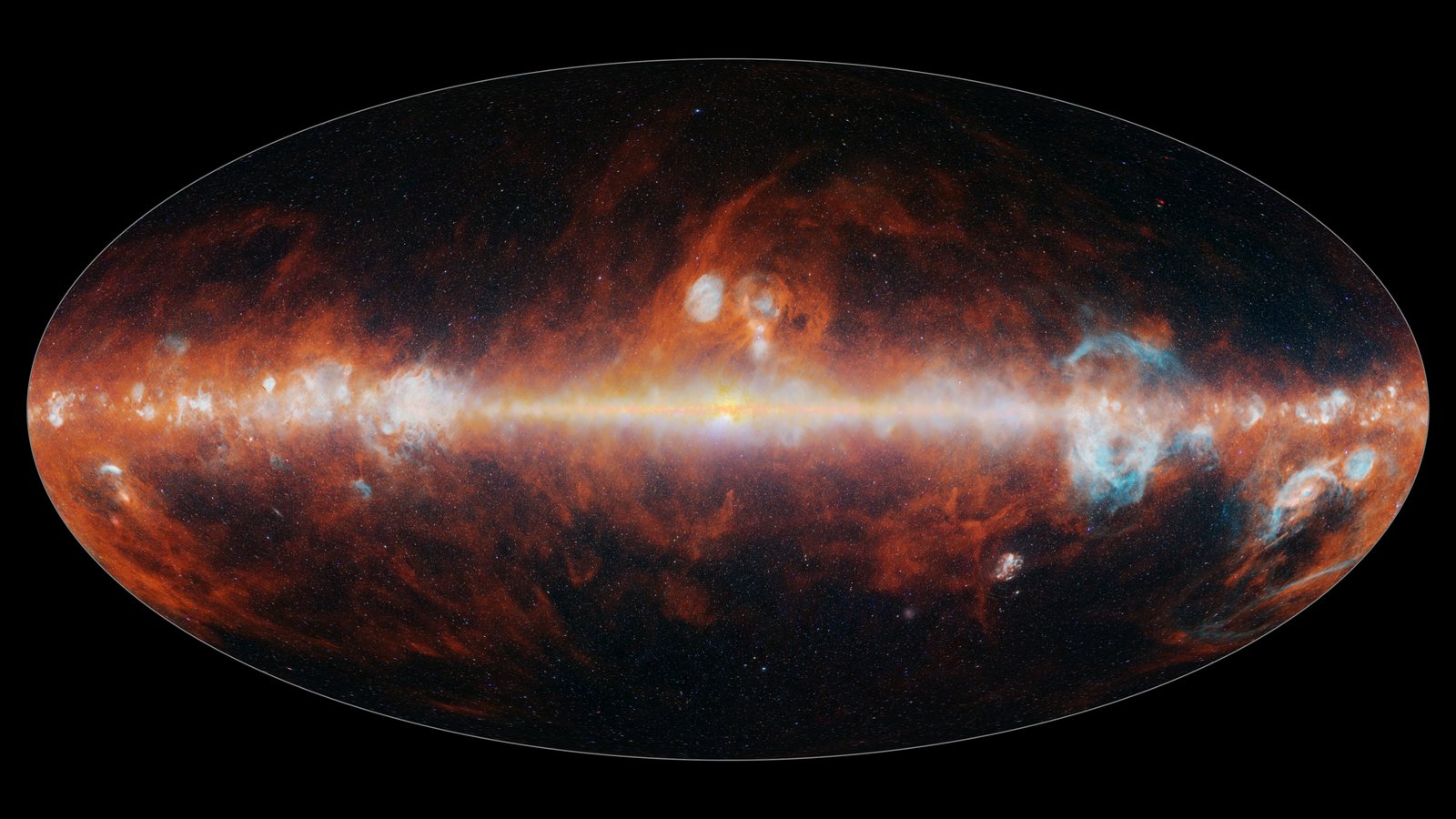
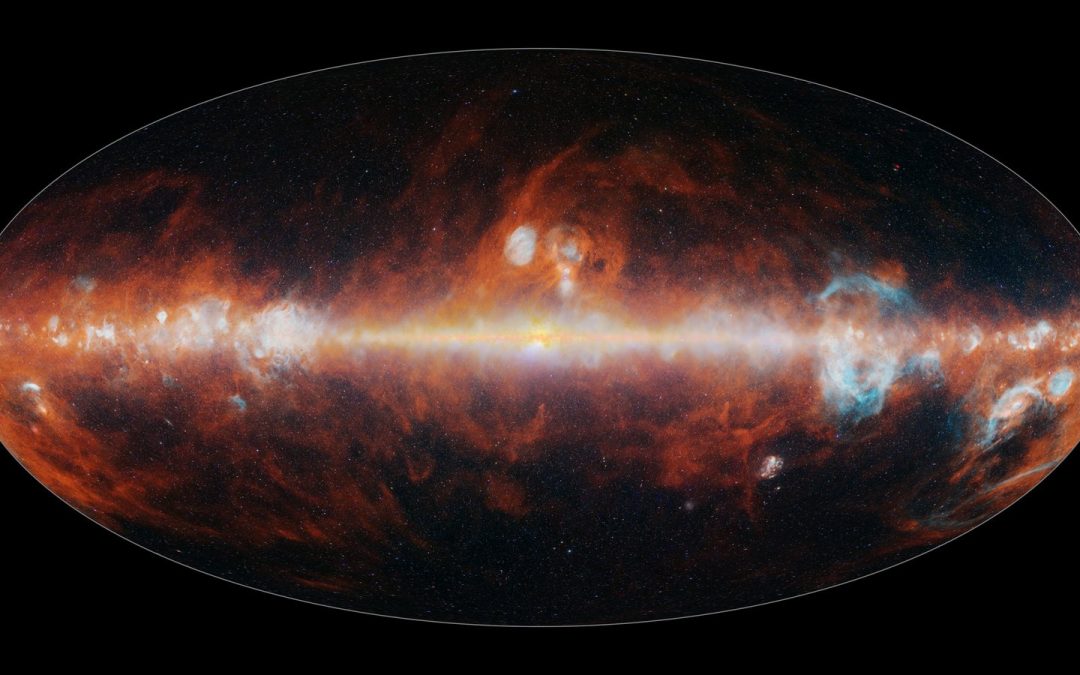
SPHEREx's first all-sky map, from observations between May and December 2025. The central band is the Milky Way; most of the points above and below it are other galaxies. NASA/JPL-Caltech.
Sources
- NASA's SPHEREx Observatory Completes First Cosmic Map Like No Other
- SPHEREx's First All-Sky Map (JPL image, PIA26600)
- SPHEREx — NASA Science mission page
- SPHEREx — NASA Jet Propulsion Laboratory
- The SPHEREx Satellite Mission — Bock et al., ApJ (arXiv:2511.02985)
- The SPHEREx Instrument: Calibration, testing and performance measurements — Korngut et al. (arXiv:2603.29835)
- Spectral response of SPHEREx — Chary et al. (arXiv:2602.09139)
- A bestiary of low-level electrical artifacts in SPHEREx flight data (arXiv:2608.09862)
- SPHEREx Explanatory Supplement, SSDC–DP–017 v2.0, 2026-08-25 (NASA/IPAC IRSA)
- SPHEREx: An All-Sky Spectral Survey — NASA/IPAC Infrared Science Archive
- Survey — SPHEREx Official Site (Caltech/JPL)
- Action! NSF–DOE Vera C. Rubin Observatory Begins Capturing the Greatest Cosmic Movie Ever Made (NOIRLab, 30 June 2026)
- The Legacy Survey of Space and Time (LSST) — Rubin Observatory