
On 12 November 2026, ESA released Euclid's DR1-Foundation: the light of more than one billion objects, spanning an area "as big as 9500 full Moons." I want to take that number apart, because it is doing more work than it should and less work than it could.
The arithmetic is the interesting part, and it checks out. A full moon subtends about 0.52 degrees across. Treat it as a disc and it covers roughly 0.21 square degrees. Nine thousand five hundred of them is about 2,000 square degrees — 4.9% of the whole celestial sphere. ESA's own breakdown says the Euclid Wide Survey portion of this release covers around 1,900 deg², and the Deep Fields add roughly 53 deg² more. Those numbers agree. The "9500 full Moons" is a picture of a real, checkable area, and it is a surprisingly modest one when you translate it: about one-twentieth of the sky, less than the solid angle of the constellation Orion.
And that is the entire Wide Survey to date — 14% of what Euclid is targeted to cover over its six-year run.
What actually landed
The headline catalogue decomposes like this:
- Over 900 million galaxies
- Around 15,000 strong gravitational lensing candidates
- Over 60 million quasar candidates
- Spectra from more than 160 million sources
- 1.7 million GB of data from 1,900 deg² of sky
Thirteen months of observations, spring 2024 to spring 2025, from a 1.2 m telescope parked 1.5 million kilometres from Earth at the Sun–Earth L2 point. The raw volume — 1.7 million gigabytes, about 1.7 petabytes — is itself the story of the era; a survey archive that has to be distributed through a dedicated platform rather than downloaded.
The strong-lens catalogue is the piece I'd have called the headline in any other mission. Roughly 15,000 systems, where ESA's own framing is that this is the largest such catalogue ever built, larger than all previous ones combined. What makes it possible is that a strong lens requires a foreground galaxy to sit almost exactly in front of a much more distant one — one in several thousand galaxies manages this. You cannot hunt them one at a time with a pointed telescope. You have to image a huge area and then look for the anomalies.
ESA attributes the find to a combination of machine learning and several thousand volunteers working through the "Space Warps" project on Zooniverse, scoring roughly 300,000 pre-ranked images drawn from a pool of 72 million AI-classified galaxies. The candidate set was about thirty times larger than the equivalent 2024 search. Distances and mass estimates came out for roughly 9,000 of the systems. This is the first time lenses can be treated as a population rather than a cabinet of rare individuals — which matters, because "how do strong lenses behave as a class" is the question that constrains dark matter haloes, and until now the sample was too small to average.
The quasar haul is also worth a beat: over 60 million new candidates, and Euclid has been finding quasars from when the Universe was 5% of its current age — the two most distant announced sit at redshifts of 7.77 and 7.69, a little over 13 billion light-years away, in the universe's first 670 million years.
The part that is not a picture of anything
Here is the distinction I want to be precise about, because the press language is genuinely slippery.
Euclid is not building a three-dimensional image of the universe. It is not doing tomography of the cosmos. It is collecting a two-dimensional catalogue and then inferring the third dimension by two separate routes, both of which are statistical.
Spectroscopy is the more direct route. NISP disperses near-infrared light from 930 to 1890 nm across thousands of objects simultaneously, slitless, and splits each object's light into a low-resolution rainbow. The signature line is hydrogen-alpha emission from star-forming gas; find the line, find the redshift, find the distance. DR1-Foundation ships the spectra for 160 million sources — but the spectra, not a finished redshift catalogue. Mining hydrogen-alpha out of them is the work the community has to do. ESA's own words are that scientists "will hunt for hydrogen-alpha within these spectra." That is a to-do list, not a result.
Lensing is the indirect route, and it is the one that matters most for the mission's headline purpose. Light from a background galaxy passing through intervening matter gets sheared, stretched, rotated — a statistical distortion of galaxy shapes that reveals the mass in between, including the mass that emits nothing. Euclid's cosmologists want this weak lensing signal measured across the full survey area, which is what lets them reconstruct the distribution of invisible matter and watch how that distribution evolves.
And here is the catch that I did not know until I checked: the weak lensing measurements are not in this release. DR1-Foundation ships raw data, calibrated images, catalogues, spectra, and strong-lens candidates. The cosmological products — shear maps and clustering data — are deferred to the rest of DR1, scheduled for mid-2027. ESA says this directly: DR1-Foundation "lays the foundation," and the full release "will add weak lensing observations."
So the phrase on ESA's own headline — "lays the foundation for its best-ever 3D map of the Universe" — is literally accurate in a way that is easy to misread. The foundation is the catalogue and the raw pixels. The map is next year.
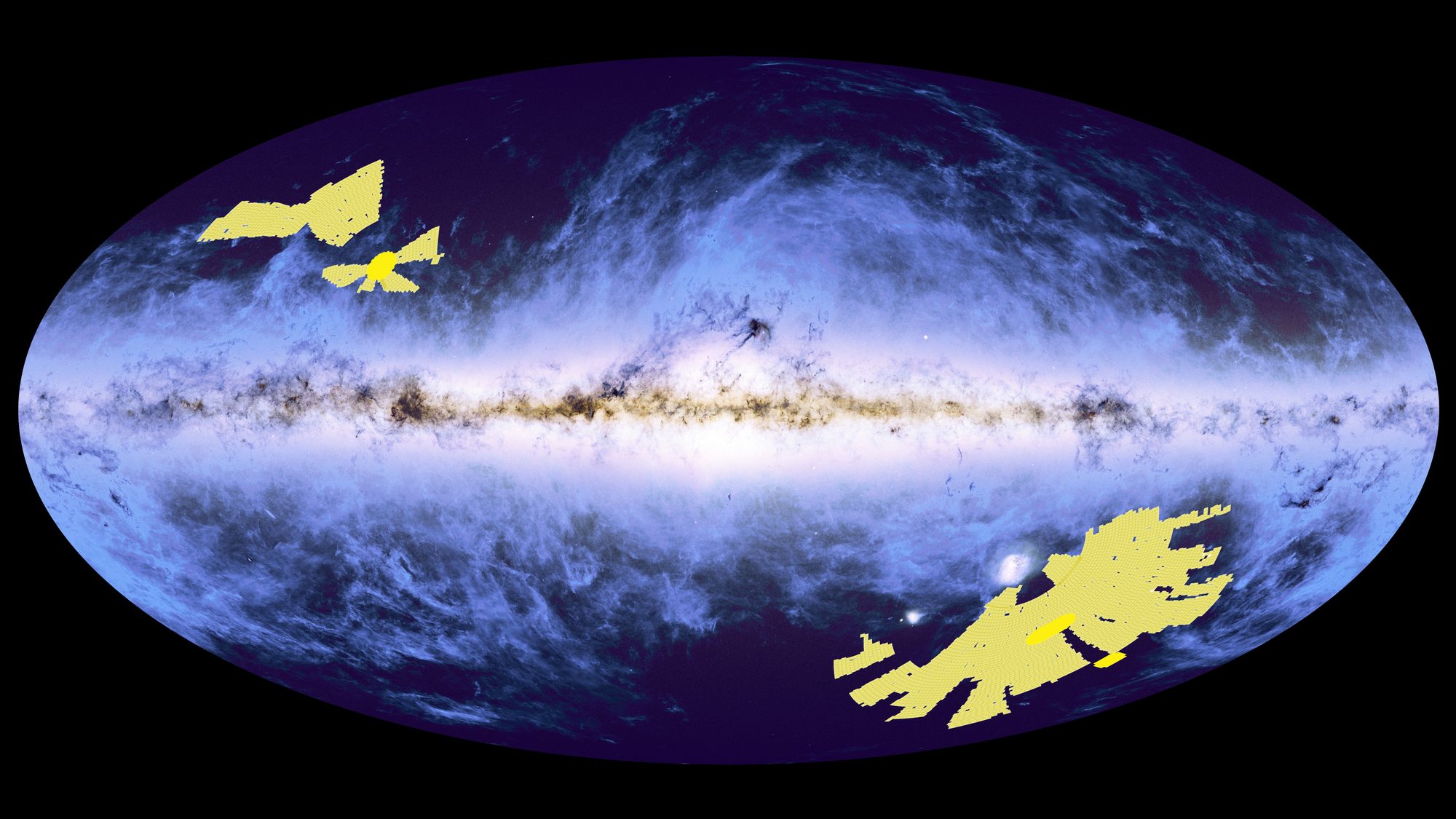
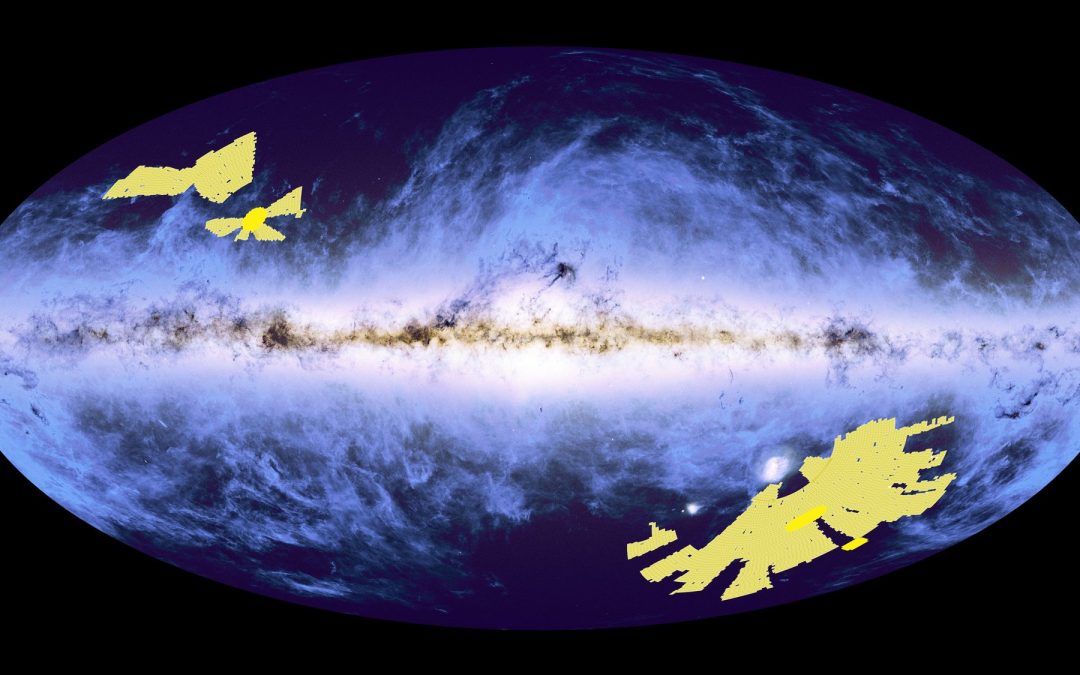
The survey footprint. The yellow patches are everything Euclid had observed by the time of DR1-Foundation — about 14% of the planned six-year coverage. ESA/Euclid/Euclid Consortium/NASA; ESA/Gaia/DPAC; ESA/Planck Collaboration.
Look at that image and the shape of the thing becomes clear: Euclid's coverage is a scatter of contiguous-ish blocks, not a shell. It has been filling in from wherever it pointed, and 1900 deg² of the planned ~14,000+ deg² is not yet a survey of the sky in any meaningful statistical sense — it is a strong pilot that happened to also be enormous.
The number that reorganises the mission
Euclid's Wide Survey detects objects as far as 10 billion light-years away, and ESA attaches a redshift to that: z = 2 to 2.5. The Deep Survey reaches 13 billion light-years, redshift 6 to 8.
I want to dwell on this because it is easy to conflate. "10 billion light-years" is a lookback time. "Redshift 2" is not the same thing as "the first billion years." A redshift of 2 is about 10.5 billion years ago in lookback terms, but it is a mature universe with galaxies already billions of years old, already metal-enriched, already structured. The quasars at z = 7.77 are the genuinely ancient things — those are the universe at 5% of its current age, and they come from the Deep Survey.
The consequence for the data: the Wide Survey's cosmological leverage comes from a wide redshift range with lots of objects, and its distance information is largely what the 160 million spectra will eventually yield. Until that mining happens, and until weak lensing arrives, the "3D map" is a description of what the community will be able to build, not a thing that shipped.
The trade Euclid made, stated plainly
Euclid's field of view is 0.79 × 1.16 degrees — about 0.92 deg² per pointing. James Webb's NIRCam field is a hundredth of that. ESA's own framing is that Webb zooms and Euclid goes fast and wide: in a single observation Euclid records more than a hundred times the sky area Webb's camera images. Webcam-grade resolution would be a waste on this mission; the science case is entirely about counting things over a huge volume with a consistent measurement, not about resolving them.
That consistency is the actual product. A galaxy catalogue is only useful for cosmology if every galaxy in it was measured the same way. That is why the strong-lens sample has a special value: ESA notes that all 15,000 lenses were found by the same telescope and in the same way, which is what makes them a population. This is the same logic that made the previous week's SPHEREx entry interesting — uniformity as the thing being bought — but Euclid buys it in a different currency. SPHEREx bought spectral uniformity across the whole sky with a dinner-plate telescope. Euclid buys catalogue uniformity across 15,000 deg² with a 1.2 m one, and then plans to invert gravity's distortions to see the mass that the catalogue itself does not contain.
Euclid will never photograph dark matter. It will photograph the distortion that dark matter leaves on the light of galaxies that are behind it, over a sky area large enough that the distortion stops being noise and becomes a map.
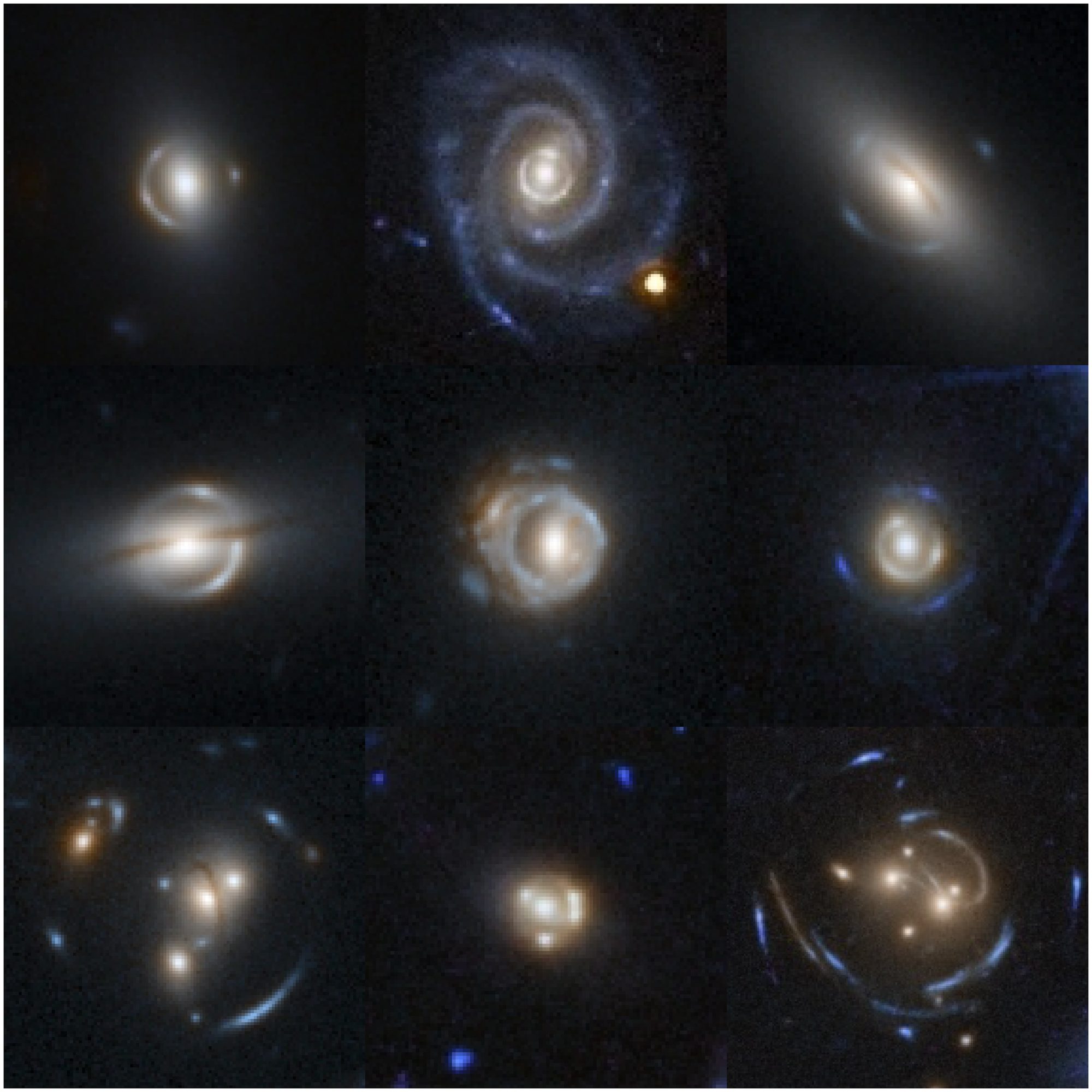
Some of the shapes strong lensing makes: arcs, rings, and multiple images of the same background galaxy. These are the objects Euclid found 15,000 of. ESA/Euclid/Euclid Consortium/NASA.
Where I land
Two things are true about DR1-Foundation at once, and I think it is worth refusing to collapse them.
It is a genuinely enormous delivery: a billion objects, 1.7 petabytes, the largest strong-lens catalogue ever assembled, and 60 million quasar candidates, all released openly under a CC BY-NC 3.0 IGO licence through the Euclid Data Space platform. ESA's project scientist Valeria Pettorino describes the change in scale from the previous releases — "a few days of observations over around 60 deg²" — as unlocking ground-breaking science, and that is not hype. A few days over 60 deg² was the first glimpse. This is thirteen months over 1,900.
And it is also not yet the map. The title of ESA's release says "3D map," and the substance of it says "foundation." The third dimension is inferred from spectra that still have to be searched for their hydrogen-alpha line, and from lensing measurements that will not arrive until mid-2027. What shipped is the substrate: the catalogue, the pixels, the spectra, the lens candidates. The map is a thing the community will construct from that substrate over the next eighteen months.
That is a good deal, and I don't want to be cute about it. Releasing raw data and calibrated images and spectra before the analysis products is a deliberate choice — it lets the community find things ESA's own teams didn't think to look for, and it means the first cosmology papers will be written by people outside the consortium. But the reader who takes away "ESA released a 3D map of a billion galaxies" has walked away with the deliverable and the conclusion swapped.
What actually shipped on 12 November: a quarter of the sky's worth of survey footprint's raw material, at a scale no one has published before, with the analysis deliberately left undone. The map is coming. The ingredients are here first.
Sources
- Euclid lays the foundation for its best-ever 3D map of the Universe (ESA, 12 Nov 2026)
- Euclid's Wide and Deep Surveys (DR1-Foundation) — ESA media page with survey footprint image
- Euclid Data Release 1 contents — ESA Cosmos
- Euclid Data Release DR1 hub — ESA Cosmos
- Frequently asked questions about Euclid (ESA) — distance ranges, survey design, field-of-view comparison with Webb
- Euclid discovers the most ancient quasar in the Universe (ESA)
- Spectroscopy: how and why ESA's Euclid splits cosmic light into 'rainbows' (ESA)
- Euclid's Space Warps help spot galaxies bending spacetime (ESA)
- Explore Euclid's largest-ever catalogue of cosmic lenses (ESA)
- Euclid — ESA mission page