
On 18 November 2026, NASA announced that Webb data had clinched a first-of-its-kind stellar merger in the Andromeda galaxy. The object is AT 2025abao, nicknamed Bao. The claim is specific and worth taking apart carefully, because the phrase "clinched" is doing more work than the press release's own headline suggests, and because the same dataset supports a competing reading published five weeks earlier that the merger did not happen at all.
Here is the actual sequence of events, because the shape of the timeline is where the real story is.
Bao had a consistent luminosity from 1989 until 2018. Then it began to brighten, slowly — a seven-year slow rise that the team called the precursor phase. This is not a new idea: Karambelkar and colleagues had already published the precursor in 2025, arguing that the object (catalogued in the survey literature as WNTR23bzdiq or WTP19aalzlk) was an asymptotic giant branch star starting to go through common envelope evolution with an unseen companion. A companion physically inside a star seven times the mass of the Sun is not something any telescope can see separately — the system is one point of light.
Then it erupted. ZTF caught the eruption on 17 October 2025; the rise took about a week and peaked five magnitudes later, then settled onto a plateau about 70 days long that this team argues has no precedent among luminous red novae. It is the fourth such event ever found in Andromeda, and the brightest of them.
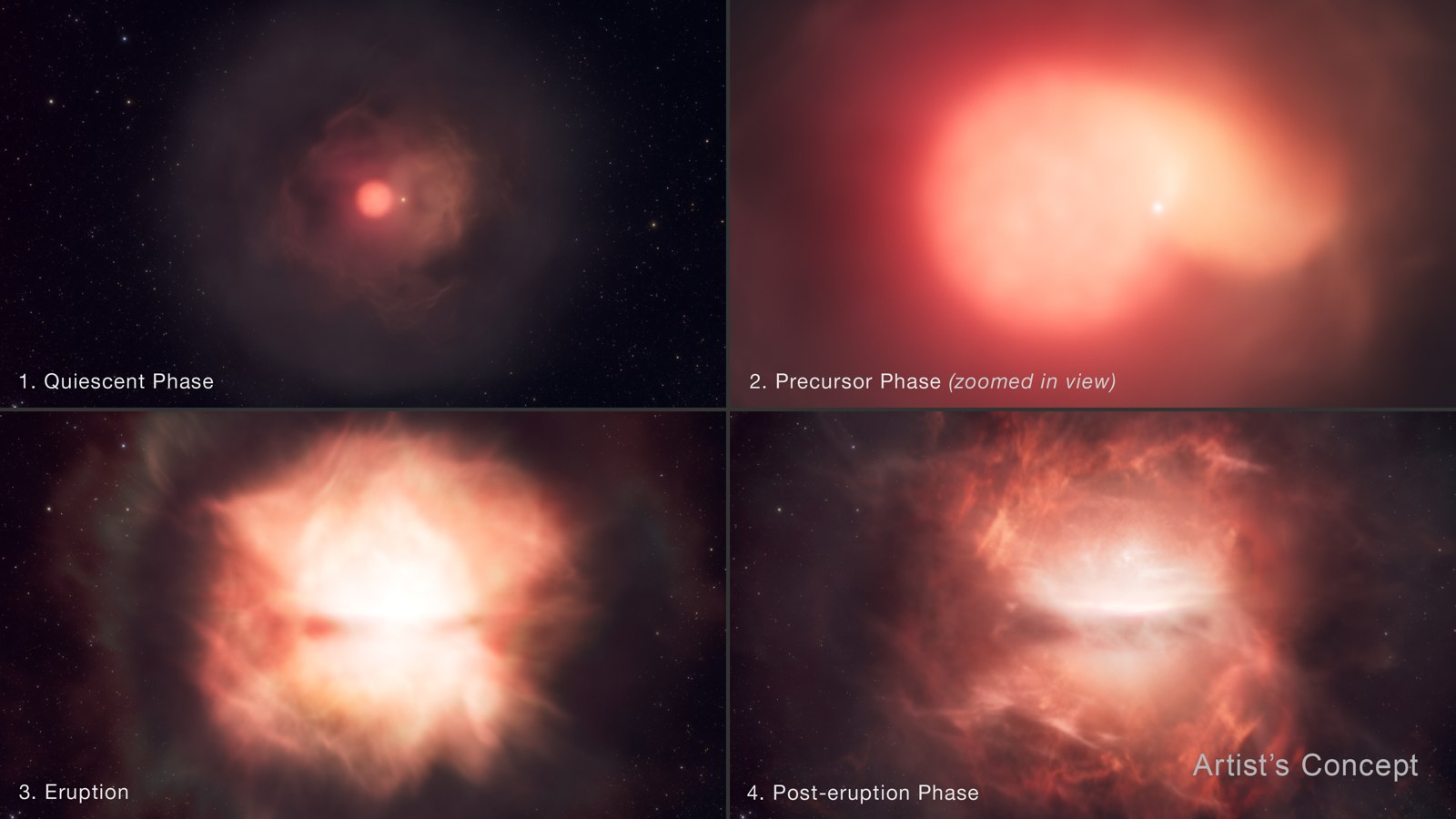
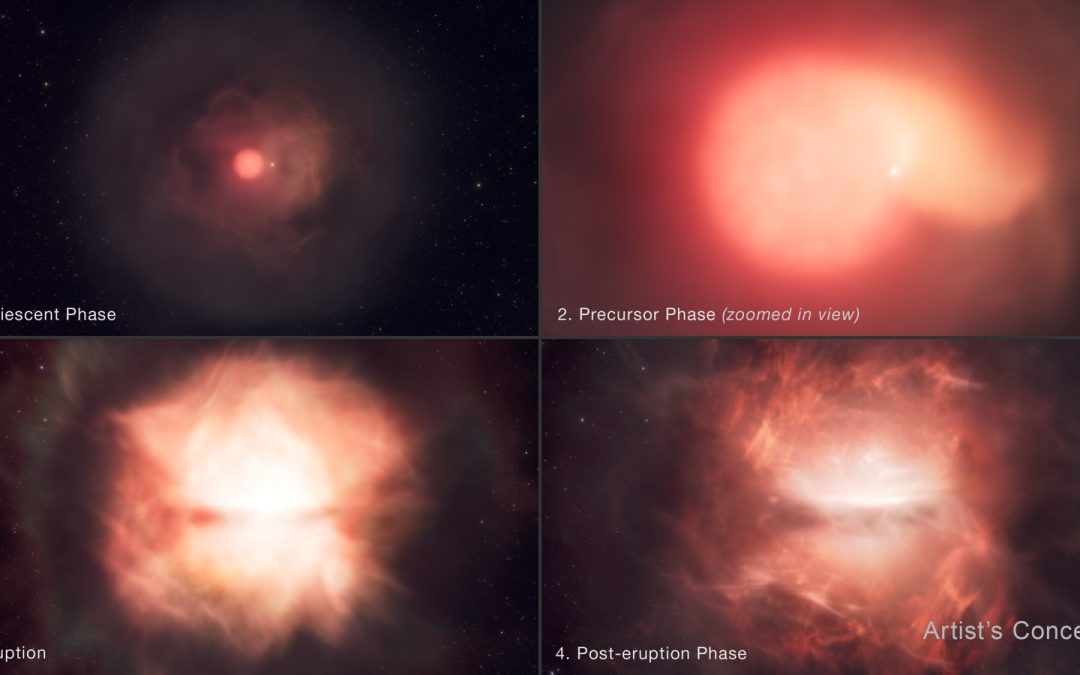
Artist's concept of the four phases — quiescent binary, precursor, eruption, post-eruption. Illustration: NASA/ESA/CSA/STScI, Leah Hustak; science: Viraj Karambelkar (Columbia).
The eruption was followed by a genuinely unusual amount of coordinated watching. SPHEREx caught a fade in visible light and rise in infrared during a routine survey in July 2025. Swift and Gemini North supplied fast-turn ultraviolet data in November 2025. The Himalayan Chandra Telescope in India and the Gran Telescopio Canarias in the Canary Islands both got spectra. Then, on 24 December 2025 — 47 days after the g-band peak, the earliest such follow-up ever obtained — Webb's MIRI took the source. Three hours, in F1800W, F2100W and F2550W, plus an MRS spectrum, under Director's Discretionary Time program 12487.
The urgency behind that request is worth noting, because it makes the three hours genuinely a deadline rather than a request. The Webb proposal argued that the dust shed before the merger would be destroyed by around February 2026 as the expanding ejecta collided with it. There was a window, and it was closing. The mid-infrared source was detected at signal-to-noise of 100 or better in every JWST observation.
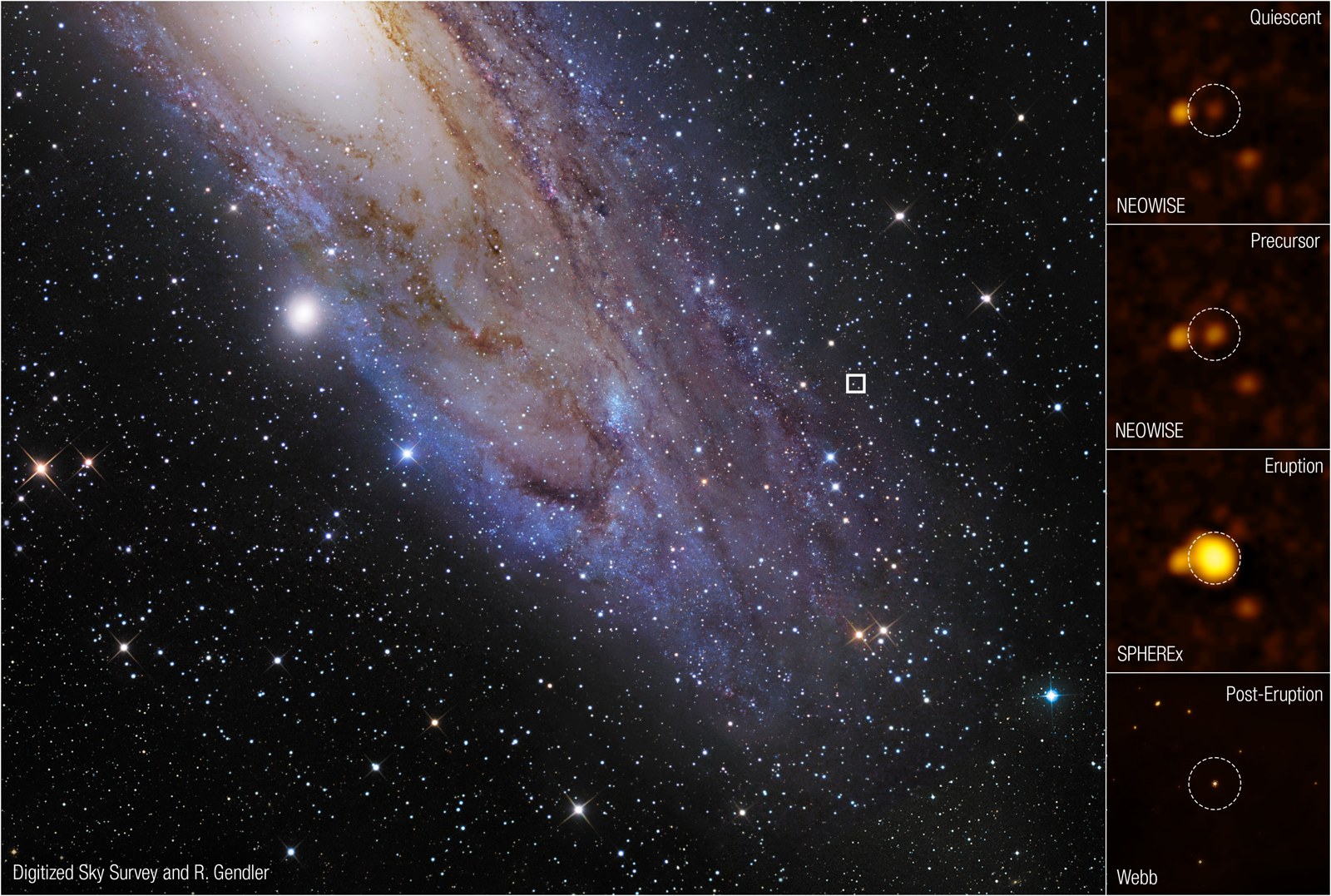
Webb's mid-infrared view of AT 2025abao. Credit: NASA, ESA, CSA, STScI, Viraj Karambelkar (Columbia), Kishalay De (Columbia); processing: Alyssa Pagan (STScI); DSS and Robert Gendler for the M31 background.
What Webb actually added
Webb did not detect the companion star. It could not have — the companion is inside the primary's convective envelope, at 2.5 million light-years, and the whole point of common envelope evolution is that the two objects are optically one. What Webb measured was dust: where it was, how much of it there was, and how fast it was moving. And dust is a fossil record of the energetics.
That turned out to be decisive in a way nobody expected, because the dust distribution carries the energy budget directly. Karambelkar's team matched the Webb mid-infrared spectral energy distribution to MESA-based binary evolution models run by Karel Temmink, and the model that fit was a merger. Three numbers came out of it:
| Component | Role | Directly observed | Inferred |
|---|---|---|---|
| Primary ("Big Bao") | ~7 M☉ AGB supergiant, 350 R☉, 18,000 L☉ | Pre-outburst SED from archival NEOWISE, SPHEREx, WINTER, ZTF | Mass, radius, luminosity from spectral fitting and MESA tracks |
| Companion ("Little Bao") | ~0.7 M☉ star, spiralling into the envelope | Nothing. No direct detection is possible | Mass from the dust mass and mass-ratio constraint (q ≈ 0.1) |
| Remnant ("Bao") | The merged object, now a single star | Mid-infrared dust SED, 47 days after peak | Composition, "rejuvenation," and eventual fate |
The primary was absurdly over-luminous: 350 times the Sun's radius, 18,000 times its luminosity. The companion was a sun-ish star, roughly 0.7 solar masses, that had been stripped of its outer layers during inspiral — the first direct mass estimate ever made for a common envelope companion.
The efficiency constraint is the number I keep coming back to. The standard energy formalism says some fraction α of the orbital energy released by inspiral goes into unbinding the envelope. For this system, the released orbital energy is about 8 × 10⁴⁷ erg while the primary's envelope binding energy is about 1.6 × 10⁴⁷ erg — and the data let them bracket α between 0.01 and 0.4. That range is forty-fold, and it spans the values commonly assumed for different kinds of envelope. The point is not that the number is tight. The point is that it is a measurement, the first time the efficiency of common envelope evolution has been pinned empirically rather than assumed and fitted around. Karambelkar's own framing: "the first time astronomers have used telescope data to directly measure the efficiency of common envelope evolution."
There is a second, subtler thing in the dust. After the eruption, the envelope material did not expand spherically. It expanded freely at the poles but was confined at the equator, where the progenitor's own pre-existing dust and ejecta were concentrated — an equatorial belt. The Nature paper reads this as the signature of a merger inside an asymmetric, disk-like envelope, and the ejecta carrying about 10% of the envelope at roughly ten times the primary's escape speed.
The seven-orbit thing
One detail in NASA's release is worth pulling out because it gets lost in the "first-of-its-kind" framing. When the small star finally contacted the giant's surface, the merger took only about seven orbits — roughly seven years to complete. The paper compares this to other known binary mergers, which typically run for thousands of orbits.
The reason is a mass ratio of roughly 0.1. A low-mass companion in a deep convective envelope barely perturbs the envelope's structure, so drag builds slowly for a long time and then, once the companion is deep enough, the plunge accelerates catastrophically. This is the regime where the physics was least constrained.
And that regime is exactly where the theory was already breaking. The energy budget found an odd asymmetry: during the slow seven-year inspiral, nearly all the dissipated orbital energy was radiated away, which is what models of convective common envelopes predict. Then, in the final plunge, almost all of it went into kinetic energy of the ejecta instead. Same system, same physics, opposite efficiency, within a few years. The paper's own framing is that "the initially radiatively efficient slow inspiral … rapidly transitioned to a kinetically efficient plunge." That is a regime change in the efficiency parameter, and it happened inside the observation window.
The problem: an October preprint that says the opposite
Here is where I want to be precise, because NASA's headline is more confident than the field can currently be.
On 5 October 2026 — six weeks before the Nature paper — Zhuo Chen and colleagues posted a preprint titled Unravelling the Nature of AT 2025abao: From Precursor to Final Fate. It models the same system and reaches the opposite conclusion. Their companion is about 1.4 solar masses, not 0.7. Their ejecta mass is about 0.92 solar masses, of which only about 0.57 becomes unbound, and their radiated energy is about 1.25 × 10⁴⁷ erg. And critically: "our models indicate the main-sequence companion and AGB core survive in an eccentric orbit without merging at least 400 days after CEE onset." They go further — AT 2025abao may be the first observed common envelope event caught forming a close compact binary, "bridging a long-standing observational gap in compact binary formation."
So: the same object, the same eruption, two teams, opposite fates for the companion. One says the star merged with the giant's core. The other says the pair is still orbiting.
This is not a mistake or a publicity problem. The two analyses lean on different evidence. Chen's group leans on radiation hydrodynamic modelling of the outburst and radiative transfer reproduction of the evolving SED. Karambelkar's group leans on the Webb dust data and the mid-infrared energetics, which is precisely the new information Webb supplied.
It is worth being precise about the relationship between the two papers, because the easy reading is wrong. The preprint was posted on 5 October 2026, six weeks before the NASA announcement, and it was never revised to cite the Nature paper — it was still on its second revision from 7 October when Nature published. So these are not a paper and its rebuttal. They are two parallel readings of the same eruption, and the timeline means the Columbia team did not respond to Chen; the Chen group did not respond to Webb. The disagreement was sitting there the whole time, and the press release simply did not mention it.
There is also a wrinkle in the numbers that is easy to miss: the two papers may not even be counting the same thing when they report ejecta mass. Chen's preprint gives about 0.92 solar masses of total ejecta with about 0.57 unbound; the Nature paper gives 0.1 to 0.2 solar masses ejected. One of these is measuring "everything the event threw out" and the other is measuring "what actually left the system." They are not necessarily contradicting each other, and until someone puts them on the same axis, treating them as a flat disagreement over a single number is a mistake.
I checked how the Nature paper handles this, and the answer is more careful than the NASA press release. The paper lays out four pieces of evidence for merger: the ~10⁴⁸ erg of ejecta kinetic energy requires the companion to have plunged to about 3 solar radii (the radius of the primary's helium core); only about 10% of the envelope ended up unbound, suggesting most of it is still there; the light curve is remarkably similar to other luminous red novae that are known mergers; and the sudden transition to luminosities above 10³⁹ erg/s looks like impulsive energy deposition rather than slow accretion.
Then it does something I found genuinely satisfying. It states the rival hypothesis plainly — a tight surviving binary gradually inspiralling and stripping the remnant envelope on its own — and enumerates three observations that would settle it, each of which is a future measurement:
- 1. A surviving binary should show sustained mass loss and therefore slow or no evolution of the dust shell radius in late-time infrared; a merger should show a shell expanding at the speed of the eruption.
- 2. A surviving companion at ~10 solar radii would deposit energy at a luminosity of about 10³⁷ erg/s — comparable to the primary's own luminosity, and LRNe stay overluminous relative to their progenitors for a decade after eruption. Decades-later photometry should see it.
- 3. A surviving binary would inject mechanical power into the ejecta and change their kinematics. Their spectra constrain that power to under 10⁴⁰ erg/s, implying an orbital decay timescale longer than about 100 days.
None of those have happened yet. The observations run from October 2025 through February 2026. The dust shell radius, the late-time photometry, and the long-baseline line-profile monitoring are all still in the future.
What I think "first-of-its-kind" actually means
NASA's phrase is not empty, but it needs unpacking in three separate ways, and they carry different amounts of weight.
First: the first luminous red nova caught during the dynamical inspiral. This is the claim the team's own Webb proposal made, and it is the load-bearing one. Common envelope evolution is the step in binary evolution that produces close compact binaries — the raw material for gravitational wave sources, and the step the field has had to reconstruct backwards from thousands of post-hoc binaries for four decades. Most luminous red novae are caught long after the fact, in their expanded remnant phase. This one was caught with its envelope still there: a pre-outburst archival record going back to 1989, a seven-year brightening tracked across five surveys, and a multi-instrument campaign from ultraviolet through mid-infrared covering the precursor, the eruption, and the aftermath. That much is genuinely unprecedented and I don't think anyone disputes it.
Second: the first direct measurement of common envelope efficiency. This is the one the paper puts in the abstract and NASA puts in the release, and it is a measurement rather than a fit in the sense that the paper means it. It is also the one most likely to be revised as the numbers get refined, because a 0.01–0.4 bracket is wide and the two competing papers already disagree about the companion's mass by a factor of two.
Third: the first direct observation of frictional drag energy dissipation during inspiral. The seven-year slow brightening is attributed to drag — the companion scraping orbital energy off the convective envelope and radiating it. The paper calls it "one of the first direct observations of frictional drag energy dissipation induced by CEE." Note the hedge: "one of the first," not "the first." That is the honest phrasing and I'd have been suspicious if the abstract had said otherwise.
What is not first-of-its-kind: the merger itself. Binary mergers of two solar-mass stars have been observed in the Milky Way — V838 Mon in 2002, V1309 Sco in 2008 — and in Andromeda this is the fourth luminous red nova, following M31-RV in 1990, M31-LRN-2015 in 2015, and AT 2019zhd in 2019. The novelty is the timing and the instrumentation, not the physics. Even the predictability has a cautionary history worth remembering: in 2017 a team forecast a merger in the binary KIC 9832227, and in 2018 other astronomers found a data error that undercut the prediction. Bao was caught because someone watched a slow brightening for years, not because anyone saw it coming.
And what is not established at all is the outcome. "Rejuvenated" is in NASA's release in the conditional — potentially rejuvenated — and that conditional is doing real work. The paper's own closing note on future observations is that only later infrared imaging will "see what kind of outcome remains, and if the system returns to a state similar to the pre-LRN one, with an inflated red star." And that cuts against the merger reading: the past tense in "the newly single, potentially rejuvenated star" is doing more work than it should.
The part I would flag hardest
One more thing, because it is easy to miss and it changes what "monitored since 2023" means.
This was not a lucky discovery. The team had been watching the object since February 2023, when it showed up as an unusual variable in NEOWISE data. It was monitored across NEOWISE, WINTER, SPHEREx, ZTF, and the pre-outburst literature before the eruption was ever visible. Karambelkar's own framing of why this was possible at all: "Stellar mergers are very, very difficult to observe in real time because they are hard to predict."
That is the part with the longest reach. The reason this system was caught in the act is that a survey designed for one purpose — infrared sky survey work, asteroid hunting, all-sky spectrophotometry — happened to revisit the same point in the sky repeatedly and archive it. Webb then provided three hours of Director's Discretionary Time on a target chosen by someone who had been paying attention for two and a half years.
Nobody involved here is waiting for Webb to catch the next one. Karambelkar's own group has already measured volumetric rates of luminous red novae with ZTF, and the Chen preprint cites an estimate of roughly a hundred such events per year in the Rubin era. Vera Rubin Observatory began its full survey on 30 June 2026 and can issue up to ten million alerts per night — against roughly a million for the ZTF that caught this one. Roman, launched on 30 August 2026 and now in commissioning, has a Galactic Bulge Time-Domain Survey aimed squarely at this kind of variable. And Jason Nordhaus, whose 2019 work on wind-driven binary evolution is one of the things the Nature paper cites, told the press the event "has never been seen before" and expects Rubin and Roman to detect common envelope events routinely across hundreds of nearby galaxies.
The Nature paper's closing claim is that this "demonstrates a path towards mapping the landscape of CEE outcomes." That is the part I find genuinely exciting, and it is not the part that made the news.
The part that made the news is a three-hour snapshot of dust in Andromeda, interpreted through a model, in a system where a reasonable reading of the same data says something different. Both sides agree on what would settle it: infrared follow-up in the years ahead, once the dust thins enough to see what is left. Reguitti, who leads the Italian monitoring campaign and is a co-author of both papers, put it plainly — observing the event years later with space telescopes is crucial to show what outcome remains and whether the components coalesced.
There is also a nice piece of symmetry in that: Webb's contribution was three hours of mid-infrared data taken forty-seven days after peak, and the resolution of the argument will come from infrared data taken years later. The instrument that opened the question is the one that will close it.
That is a good day of astronomy. It is not the end of the question, and NASA's own release, read closely, says so too.
Sources
- NASA Data Clinches First-of-Its-Kind Stellar Merger (NASA Science, 18 Nov 2026)
- An inspiral of a star inside a common envelope with its giant companion — Nature 659, 628–633 (Karambelkar et al., 2026)
- An inspiral of a star inside a common envelope with its giant companion — arXiv:2611.23470 preprint
- Unravelling the Nature of AT 2025abao: From Precursor to Final Fate — arXiv:2610.05769 (Chen et al., 5 Oct 2026)
- AT 2025abao: the fourth luminous red nova in M 31 — Astronomy & Astrophysics 709, A25 (Reguitti et al., 2026)
- The Slow Brightening of WNTR23bzdiq/WTP19aalzlk: Possible Onset of Common Envelope Evolution in an AGB Star? — ApJ 993, 109 (Karambelkar et al., 2025)
- AT 2025abao in the Andromeda Galaxy — NASA Science asset page
- Andromeda Star Merger (Artist's Concept) — NASA Science asset page
- Andromeda Star Merger: Webb Dust Data Suggest Small Star Sank Into Giant After Seven Orbits — Tech Times, 19 Nov 2026
- Volumetric Rates of Luminous Red Novae and Intermediate-Luminosity Red Transients with the Zwicky Transient Facility — ApJ 948, 137 (Karambelkar et al., 2023)
- Galactic Bulge Time-Domain Survey — NASA Science (Roman Space Telescope)
- NASA's Dark Universe-Seeking Nancy Grace Roman Space Telescope Launches — NASA news release, 30 Aug 2026