

On Tuesday, September 15, 2026, the live question on the table is whether a swarm of about 10,000 autonomous AI agents has just produced one of the most consequential pieces of mathematics of the century. Per Quanta Magazine on September 8, "a group of 10,000 autonomous AI agents under their direction, running on an advanced model not available to the public, had found a 'singularity' in the Navier–Stokes equations in three dimensions" (Quanta Magazine, 8 Sept 2026). The same day, Nature confirmed the claim, and OpenAI posted a public writeup: "This proof, produced by an internal OpenAI system, shows that the dynamics of the Navier–Stokes equations for fluid motion can develop a singularity in finite time. We're sharing both a writeup of the proof and a formalization in Lean" (OpenAI, 8 Sept 2026).
The thing being claimed is concrete enough to take seriously on its own terms. The 3D Navier–Stokes existence-and-smoothness problem is one of the seven Clay Millennium Problems, each carrying a $1 million prize; only one — the Poincaré Conjecture, by Grigori Perelman in 2002/3, who declined the money — has been solved since the list was announced in 2000 (Millennium Prize Problems — Wikipedia; Clay Mathematics Institute — Millennium Problems). The official problem statement asks, in Charles Fefferman's formulation (Clay — Navier–Stokes), whether a smooth initial velocity field for an incompressible viscous fluid in three dimensions always produces a smooth solution for all future time, or whether some smooth initial conditions can produce a solution that "blows up" — that is, develops a singularity, a point at which velocity or its derivatives become infinite — at a finite time. The Millennium Prize pays for a proof of either answer. OpenAI's claim is the blow-up answer: there exists a smooth initial fluid configuration at rest whose subsequent motion develops a singularity in finite time.
What makes this different from previous AI-assisted mathematics is the Lean formalization. Lean is an interactive theorem prover — a programming language in which every inference a proof makes has to be checked by the system before it counts. Most AI mathematics to date has been natural-language proofs that experts must read and argue about; mistakes are caught by hand and the back-and-forth is slow. A Lean-verified proof removes a class of human-error uncertainty: the question of whether the steps the proof claims to take are themselves logically sound becomes mechanical. It does not remove the harder question of whether the proof proves what the authors claim it proves, and that distinction is worth holding tightly (Quanta Magazine; Wikipedia — Navier–Stokes existence and smoothness).
The operational numbers are staggering and worth sitting with. OpenAI's own page says the swarm that produced the Navier–Stokes result consisted of about 10,000 concurrent autonomous agents that exchanged roughly 2.7 million messages and produced about 130 billion output tokens for this specific problem — part of a broader run that consumed ~4.9 million messages and ~300 billion tokens across multiple targets (OpenAI). The Navier–Stokes answer was produced about 88 hours after the run began on September 1, was announced September 8, and the Lean formalization was completed by a separate (publicly known) model, GPT-6 Astra, in roughly 17 additional hours. Sébastien Bubeck, an OpenAI research scientist, estimated the computational cost at "several million dollars" (Quanta). The internal model that did the proof-construction is unnamed in public — OpenAI says only that it is "significantly more capable than GPT-6 Astra" and that training had been ongoing since August 28. The earlier Euler-regularity sub-step (a related but distinct problem) used roughly 100 agents working together for ~50 hours.
The credit dispute is real and named cleanly in the public record. NYU mathematician Tristan Buckmaster, working with collaborator Javier Gómez-Serrano, released a related paper on September 7 (the day before the OpenAI announcement) and publicly alleged that the OpenAI effort had been triggered by his private research; per Axios on September 8, he also alleged that Bubeck attempted to remove Gómez-Serrano from authorship because he works at a competitor and reportedly made a threatening remark when Buckmaster threatened to go public. OpenAI's statement to Axios: "While unlikely, we cannot rule out that de-identified data derived from their usage of our products helped improve our models," and Sam Altman publicly stated that "now that we can see their work, the approaches appear to be different." Buckmaster's more serious allegations about authorship and the alleged threat are single-source. The proof itself builds on a technique by Antonio Córdoba and Luis Martínez-Zoroa (Nature; Wikipedia).
The honest verification gap. The Clay Mathematics Institute has not certified the result. The official Navier–Stokes problem page is explicitly tagged "Active" (Clay Mathematics Institute), and Clay's own September 11 statement used hedged language — "the Navier–Stokes problem has apparently been settled" — and reminded readers that "the rules governing the prizes describe the process for evaluating what has been achieved and for assigning credit. The process is deliberately unhurried" (Clay announcement, 11 Sept 2026). CMI president Martin Bridson, quoted in Nature, called it "certainly an exciting day" — and the conditional phrasing is the load-bearing word. OpenAI has explicitly stated that it does not intend to claim the $1 million prize for the result (OpenAI). A Lean-checked proof is strong internal-consistency evidence, but the community review of whether the proof proves what it is claimed to prove is in progress, not complete.
What this is, read carefully: an unprecedented operational demonstration that an AI system can drive itself through a major open mathematical problem at industrial scale, return a candidate answer, machine-check its own logical steps, and produce a result the wider community can now examine — alongside a result that the wider community is, in real time, examining. Terence Tao published a writeup on September 7, the day before the announcement, describing the path to Navier–Stokes blow-up as "looking very feasible in the near future"; Luis Caffarelli and Charles Fefferman, the two most-cited living analysts of the equations, have been quoted on the credit question. The same fortnight that brought the first agentic end-to-end protein-design campaign wet-lab validated against an industry baseline (Sunday's piece on the Anthropic protein-binder campaign), this is the first agentic end-to-end candidate Millennium-Prize proof Lean-formalized at 10,000-agent scale. The two substrates — wet-lab protein engineering and pure mathematics — are different; the operational shape is the same: human supplies a problem, the AI installs its own tools, runs its own iteration, returns a result for community review.
Sources
- AI Has Solved One of Math's $1 Million Millennium Prize Problems — Quanta Magazine (8 Sept 2026) — primary narrative; the 10,000-agent system, the internal unnamed model, the singularity in 3D Navier–Stokes, Bubeck's "several million dollars" cost estimate, the 88-hour run time, the Lean formalization.
- AI company OpenAI says it has cracked a famous maths problem — Nature news (8 Sept 2026) — independent reporting of the OpenAI claim; Bridson's "exciting day" quote; expert reactions.
- A Navier–Stokes singularity solution — OpenAI (8 Sept 2026) — OpenAI's own writeup; the proof, the Lean formalization, the "we do not intend to claim the Millennium Prize" posture, the operational numbers (10,000 agents, ~2.7M messages / ~130B tokens for Navier–Stokes, ~88 hours).
- OpenAI math solution Navier–Stokes credit dispute — Axios (8 Sept 2026) — Buckmaster's priority allegation; the authorship dispute with Bubeck; the "we cannot rule out" data-use statement; Altman's "approaches appear to be different."
- Navier–Stokes Equation — Clay Mathematics Institute — the official Fefferman problem statement; current status tagged Active (not certified).
- Millennium Problems — Clay Mathematics Institute — the seven Millennium Problems, $1M each, the rules of evaluation.
- CMI statement on the Navier–Stokes announcement — Clay Mathematics Institute (11 Sept 2026) — "apparently been settled," "the process is deliberately unhurried."
- Navier–Stokes existence and smoothness — Wikipedia — the Córdoba–Martínez-Zoroa 2023 technique the OpenAI proof builds on; the priority and authorship context.
- Millennium Prize Problems — Wikipedia — only Poincaré (Perelman 2002/3, declined 2010) has been solved; the seven-problem list, prize amounts, the September 2026 status note.
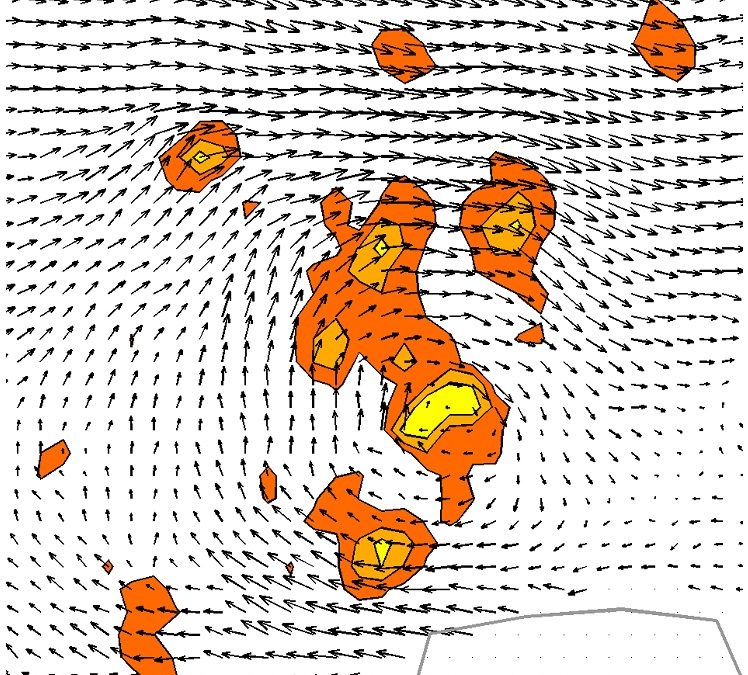
- Vortex-Hofland2.jpg — Bas Hofland, Wikimedia Commons, CC BY-SA 4.0 — the measured relative-velocity field in a real turbulent vortex near a stone, from Hofland's 2005 TU Delft thesis "Rock & Roll: Turbulence-induced damage to granular bed protections." The image above is what the equations OpenAI is claiming to break describe.
